

Table of Contents
01 Dead Pixel Rate | 02 Surface Flatness | 03 Brightness Standards | 04 Viewing Angle | 05 White Balance | 06 Color Reproduction | 07 Mosaic Effects & Dead Zones | 08 Color Block Uniformity | 09 Long-Term Stability | ✓ Quality Evaluation Checklist
Purchasing an LED display — whether for a concert stage, an outdoor billboard, or a corporate environment — is a significant investment. The difference between a high-performance display that runs reliably for 10+ years and one that fails within months often comes down to a handful of measurable quality indicators.
This guide draws on internationally recognized standards — including guidelines from the International Electrotechnical Commission (IEC) and industry benchmarks established by AVIXA (Audiovisual and Integrated Experience Association) — to give you a complete framework for evaluating LED display quality before, during, and after installation.
Whether you are sourcing a rental LED display for a live event, a permanent outdoor advertising LED screen, or a commercial indoor LED video wall, the standards below apply universally.
The table below summarizes the 9 key metrics covered in this guide:
| Quality Metric | Standard / Acceptable Range | Why It Matters |
|---|---|---|
| Dead Pixel Rate | ≤ 0.3% (3 per 1,000) | Affects image uniformity and display professionalism |
| Surface Flatness | ± 1mm | Prevents visual distortion and dead viewing angles |
| Indoor Brightness | ≥ 800 cd/m² | Ensures visibility in ambient light conditions |
| Outdoor Brightness | ≥ 5,000 cd/m² | Required for full daylight readability |
| Viewing Angle | ≥ 150° | Determines audience reach and coverage |
| White Balance RGB Ratio | 1 : 4.6 : 0.16 | Ensures accurate, neutral colour reproduction |
| Module Gap | < 1mm | Prevents visible seams, critical on P3 and below |
| Control System Greyscale | ≥ 14-bit / ≥ 3,840 Hz | Eliminates banding, supports camera capture |
| Operational Lifespan | 80,000 – 100,000 hours | 10+ years of continuous 24/7 operation |
A dead pixel — also referred to as a fault point — is a pixel element that cannot operate correctly. It may present as a permanently dark point (not illuminated), a constantly bright point (always-on), or an abnormally bright point that does not respond to signal input.
Industry standards, including those published by the IEC for flat panel display measurements, establish acceptable thresholds that manufacturers must adhere to:
- ▸Dead pixel rate must not exceed 0.3% (3 pixels per thousand) of total pixel count
- Dead pixels identified post-installation must be repaired promptly to maintain display integrity
- Mosaic defects — entire module failures showing as solid black or white blocks — indicate IC chip or connector failure, not LED chip failure, and require separate diagnosis
Request factory acceptance test (FAT) documentation showing pixel fault rates for the specific batch of panels. Reputable manufacturers like VMX Visual conduct 100% panel inspection before shipment.
Surface flatness refers to the planarity of the LED display surface — how consistently flat the panel face is across module-to-module and cabinet-to-cabinet junctions. It is one of the most underestimated quality indicators in LED display procurement.
Any local protrusion or depression creates dead viewing angles — portions of the display that cannot be seen from standard positions. The professional standard requires:
- ▸Surface flatness tolerance: ± 1mm across the entire display face
- ▸Inter-module gap (cabinet-to-cabinet): < 1mm
- For fine-pitch displays (P3 and below): zero visible gap — any gap creates visible black lines during content playback
Surface flatness is determined by three factors: manufacturing precision of the module, quality of structural mounting hardware, and the skill of the installation team. Even a premium panel can suffer flatness issues if installation standards are not enforced.
VMX Visual's stage rental LED panels are engineered with precision die-cast aluminum cabinets to ensure consistent flatness across large-format assemblies — a critical requirement for broadcast and live event environments.
Brightness — measured in candelas per square metre (cd/m², commonly called "nits") — determines readability across different ambient light conditions. According to AVIXA's display specification standards:
- ▸Minimum brightness: 800 cd/m²
- Typical professional installations: 800 – 1,500 cd/m²
- XR studio and virtual production: 1,200 – 2,500 cd/m² (to support camera exposure requirements)
VMX Visual's XR studio LED displays are specifically engineered to meet the demanding brightness and refresh rate requirements of in-camera virtual production workflows.
- ▸Minimum brightness: 5,000 cd/m²
- High-ambient environments (direct sunlight): 6,000 – 10,000 cd/m²
- Roadside and stadium advertising: 5,000 – 7,500 cd/m² is standard
Brightness is not a "more is always better" metric. Driving LED panels beyond their rated current to artificially inflate brightness accelerates lumen depreciation and significantly shortens panel lifespan. Always verify brightness specifications against the manufacturer's rated drive current, and request an independent photometric test report.
The viewing angle defines the maximum angle from which display content remains clearly visible without significant colour shift or brightness drop-off. Professional LED displays must achieve:
- ▸Minimum viewing angle: 150° horizontal and vertical
- SMD (Surface-Mounted Device) packaging — standard on all modern professional LED displays — achieves wide viewing angles by design
For outdoor advertising LED screens, wide viewing angles are critical to maximizing the number of viewers who can clearly read the content — directly impacting advertising ROI.
White balance refers to the calibration of the red, green, and blue (RGB) sub-pixel channels to produce a neutral, accurate white output.
Pure white is only produced when the RGB luminance ratio is precisely Red : Green : Blue = 1 : 4.6 : 0.16. Any deviation causes white balance shift — images appear too blue (cool) or too yellow-green (warm).
- ▸LED chip wavelength consistency: chips must be binned to tight wavelength tolerances at the factory
- ▸Control system calibration: the display controller must support sub-pixel-level gamma correction and colour mapping
For broadcast or colour-accurate retail displays, on-site colorimeter measurement after installation is recommended. Reference standards from the Society of Motion Picture and Television Engineers (SMPTE) provide benchmarks for colour accuracy in broadcast LED environments.
Color reproduction fidelity measures how accurately the LED display renders the full color gamut of the source signal. Poor reproduction systematically shifts hues — making product colors inaccurate in retail environments or skin tones unnatural in broadcast.
- ▸Color gamut coverage: expressed as a percentage of sRGB, DCI-P3, or Rec.2020 color space
- ▸Delta-E (ΔE) value: ΔE < 3 is acceptable for professional applications; ΔE < 1 is imperceptible to the human eye
- ▸Gamma curve accuracy: the luminance response curve should match target gamma (typically γ = 2.2 for standard content)
While individual dead pixels indicate isolated LED chip failures, mosaic defects indicate systemic failures at the module or IC level — presenting as a solid-coloured block covering an entire module (typically an 8×8 or 16×16 pixel area).
- ▸IC chip failure: the most common cause, often related to ESD (electrostatic discharge) damage during manufacturing or handling
- ▸Connector failure: poor-quality ribbon cables or PCB connectors causing signal loss to an entire module
- ▸Sealant defects: inadequate moisture sealing leading to corrosion of module electronics
The IPC-A-610 standard (Acceptability of Electronic Assemblies) provides widely referenced criteria for evaluating PCB and electronic assembly quality in LED display manufacturing. Request evidence of IPC-A-610 compliance from any supplier.
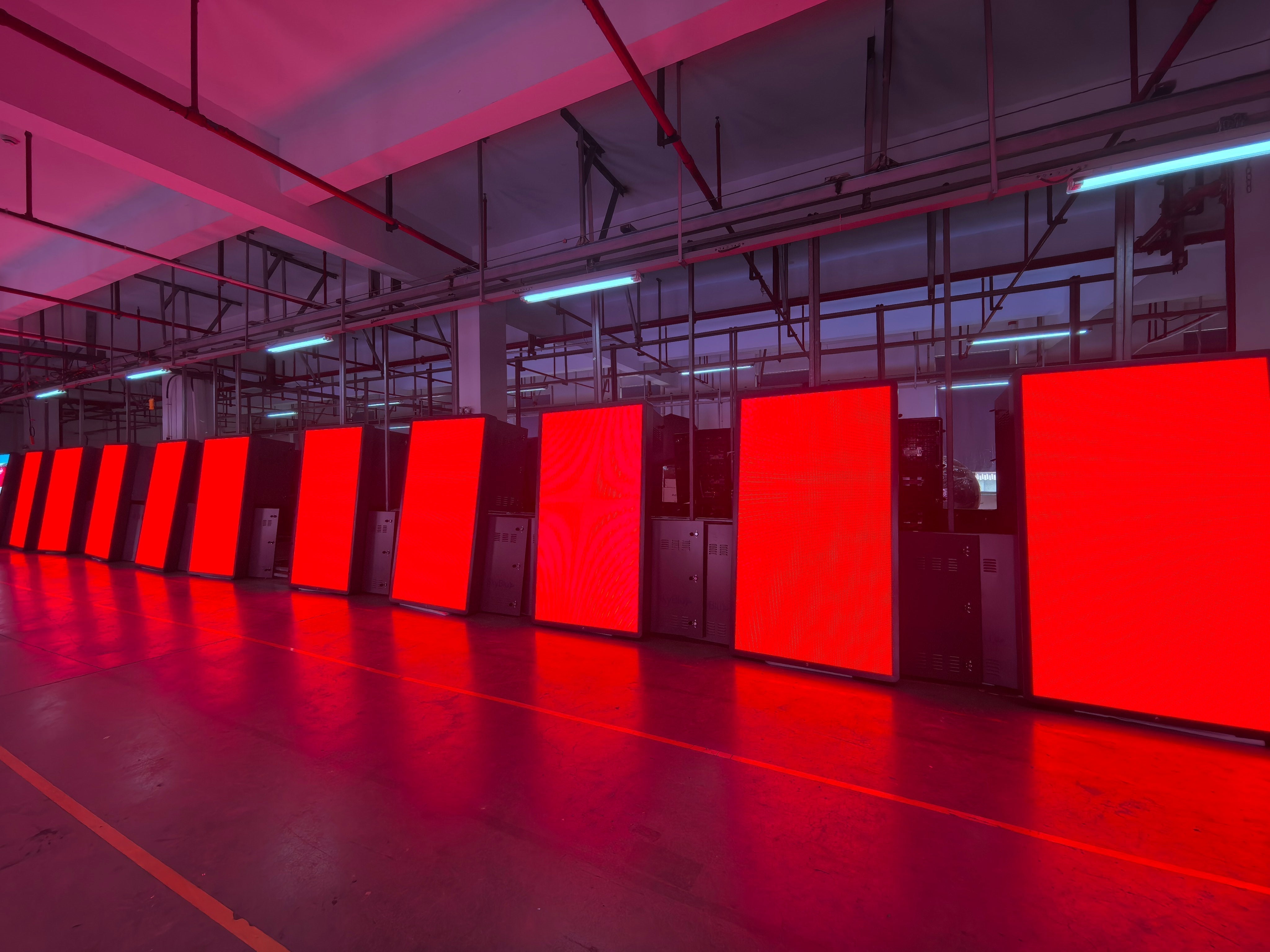
Color block non-uniformity — visible colour differences between adjacent modules — is caused not by LED chip quality, but by control system performance. Symptoms include colour gradients at module boundaries, brightness steps between neighbouring cabinets, and banding patterns during full-screen colour tests.
- ▸Greyscale depth: ≥ 14-bit processing (16,384 greyscale levels)
- ▸Refresh rate: ≥ 3,840 Hz for flicker-free camera capture
- Point-by-point brightness and chrominance calibration capability

An LED display's rated lifespan is 80,000 to 100,000 hours — approximately 9–11 years of continuous 24/7 operation. This figure is only achievable if the display passes rigorous factory aging testing before shipment.
- Continuous full-load operation at rated brightness for 24–72 hours
- Thermal cycling tests to verify performance across the rated temperature range
- Vibration and mechanical stress testing for rental panels
Always request the aging test record for your specific shipment batch. For outdoor LED displays, additionally verify IP rating certification (minimum IP65) against the IEC 60529 ingress protection standard.
Before finalising any LED display purchase or rental agreement, verify the following with your supplier:
- ✓ Dead pixel rate documentation (≤ 0.3%)
- ✓ Surface flatness test report (± 1mm tolerance)
- ✓ Brightness specification and photometric test (≥ 800 cd/m² indoor / ≥ 5,000 cd/m² outdoor)
- ✓ Viewing angle certification (≥ 150°)
- ✓ White balance calibration report (RGB ratio 1 : 4.6 : 0.16)
- ✓ Control system greyscale depth and refresh rate (≥ 14-bit / ≥ 3,840Hz)
- ✓ Factory aging test records for the specific shipment batch
- ✓ IP rating certification for outdoor installations (IEC 60529, minimum IP65)
- ✓ International certifications for your market: CE, FCC, UL, RoHS
References & Standards
- International Electrotechnical Commission (IEC) — Flat panel display measurement standards
- AVIXA — Audiovisual display and brightness specification standards
- SMPTE — Colour accuracy standards for broadcast LED environments
- IPC-A-610 — Acceptability of Electronic Assemblies standard
- IEC 60529 — Degrees of protection provided by enclosures (IP Code)


Share:
Lunar New Year Holiday Schedule 🏮
Join VMX Visual for an Exclusive Factory Experience Before ISLE 2026