
Table of Contents
01 What Drives the Price | 02 Panel Cost Breakdown | 03 Hidden Costs | 04 Installation Costs | 05 Ongoing Costs | 06 Factory-Direct vs Distributor | 07 Why Quotes Differ So Much | 08 How to Compare Quotes | ✓ Budget Checklist | FAQ
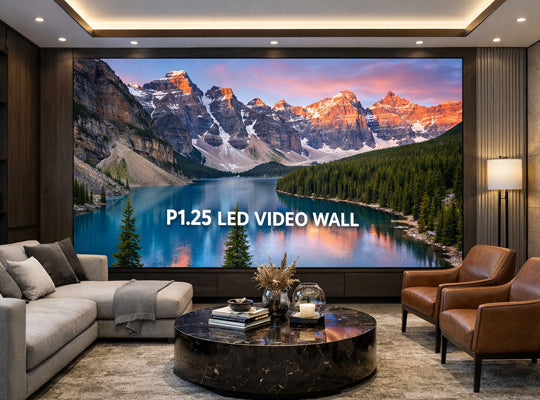
You've requested three quotes for a P1.25 indoor LED video wall. One is $8,000/m². One is $12,000/m². One is $22,000/m². All claim to be P1.25. All claim to be high quality. The question is not which supplier to trust — it's why the prices are so different, what those differences actually mean, and what costs aren't showing up in any of those quotes. This guide breaks down every cost component of a P1.25 indoor LED video wall project in 2026.
P1.25 is one of the finest pixel pitches in commercial LED display production. At 1.25mm between pixel centres, a single square metre contains approximately 640,000 individual LED pixels — each consisting of red, green, and blue sub-pixels. The density of components at this pitch means that component quality has a disproportionate impact on both price and long-term performance compared to larger pixel pitches.
Four factors account for the majority of price variation between P1.25 suppliers:
- ▸LED chip brand and bin grade — First-tier LED chips from Nationstar, Cree, or EPISTAR cost significantly more than second-tier or rebinned chips. At P1.25 density, LED chip cost represents 40–55% of total panel cost. A supplier using downgraded chips can offer a substantially lower price while claiming the same pixel pitch.
- ▸Driver IC quality — Macroblock, MBI, and ICN driver ICs are the professional standard for fine pitch displays. Lower-cost alternatives have shorter rated lifespans and higher failure rates. Driver IC cost represents approximately 15–20% of panel cost at P1.25.
- ▸Cabinet construction and manufacturing precision — Fine pitch displays require tighter mechanical tolerances than larger pixel pitches. Cabinet flatness, module alignment accuracy, and connector quality directly affect seam visibility and long-term panel stability. Precision manufacturing costs more.
- ▸Supply chain position — A manufacturer quoting direct will be 20–35% lower than a distributor quoting the same product. Many online LED display listings are resellers, not manufacturers. The cheapest quotes are often resellers of the lowest-specification products — a double disadvantage.
The following cost ranges reflect 2026 factory-direct pricing from China for P1.25 indoor LED display panels. All figures are approximate and vary by order volume, specification, and supplier.
| Specification Tier | Panel Price (per m²) | Key Differentiator |
|---|---|---|
| Entry-level | $4,500 – $7,000 | Second-tier LEDs, no-brand ICs, basic cabinet |
| Mid-range | $7,000 – $12,000 | Nationstar or equivalent LEDs, Macroblock ICs |
| Professional | $12,000 – $18,000 | Top-tier LEDs, Macroblock ICs, precision cabinet |
| Premium / Branded | $18,000 – $35,000+ | European/Korean brand premium, full local support |
These are panel-only prices. They do not include the control system, video processor, installation, cabling, structural mounting, software, or ongoing maintenance. A panel-only quote for a 10m² installation at $10,000/m² ($100,000) will typically become a $140,000–$160,000 project once all additional costs are included.
The gap between a supplier's quoted price and the actual project cost is one of the most consistent sources of budget overruns in LED video wall projects. These are the costs that most initial quotes do not include:
- ▸Control system and sending card — NovaStar or Colorlight sending cards and control software are often quoted separately or not quoted at all. Budget $800–$3,500 for a professional control system depending on resolution requirements. Annual software licence adds $200–$600/year.
- ▸Video processor — A dedicated video processor or scaler is required for complex signal routing, multi-source switching, or high-resolution inputs. Budget $1,500–$8,000 depending on input requirements. Many first-time buyers do not realise this is a separate component until after the panels are delivered.
- ▸Structural mounting hardware — Wall mounting brackets, floor stands, suspension rigging, or custom fabricated frames are not included in panel prices. Budget $500–$5,000+ depending on installation type. Custom architectural integration can cost significantly more.
- ▸Cabling and cable management — Signal cables, power distribution, cable conduit, and cable trays are rarely included in supplier quotes. Budget $300–$2,000 for a standard installation, more for complex environments with long cable runs or concealed routing requirements.
- ▸Content adaptation — Existing content (presentations, videos, graphics) almost always requires reformatting for the specific LED wall resolution. Budget $500–$3,000 for content adaptation depending on content volume and complexity.
- ▸Spare module stock — Professional installations require a minimum 5% spare module inventory for on-site rapid replacement. For a 10m² P1.25 installation, this typically means holding 2–4 spare modules. Budget 5–8% of panel cost for initial spare stock.
- ▸Import duty and freight (non-EU warehouse purchases) — LED displays imported from China into the EU are subject to customs duty of approximately 3.7% of declared value, plus VAT. For a $100,000 panel order, this adds approximately $3,700 in duty plus applicable VAT before local installation. Suppliers with EU warehouse stock eliminate this cost entirely.
Installation cost for an indoor P1.25 LED video wall is determined by the complexity of the mounting environment, cable routing requirements, and the level of AV integration needed. The following ranges apply to professional installation in European markets in 2026:
- ▸Simple wall-mount installation (up to 10m²) — Standard wall bracket mounting, surface cable routing, basic control system setup. Typical cost: €1,500–€3,500 for a one to two person crew over one to two days.
- ▸Complex AV integration (10m²–30m²) — Concealed cable routing, custom structural frame, multi-source signal integration, extended calibration. Typical cost: €4,000–€12,000 depending on scope.
- ▸Large-scale or architectural integration (30m²+) — Custom fabricated mounting, building services coordination, full AV commissioning. Cost varies significantly by project — budget 15–25% of panel cost as a starting estimate.
Suppliers with EU warehouse stock (Belgium, Italy, France) can deliver P1.25 panels within 3 to 7 business days, allowing installation to be scheduled immediately after order confirmation rather than waiting 4 to 8 weeks for factory production and ocean freight. This can reduce total project timeline by 3 to 5 weeks — a significant cost saving when installation labour and venue booking are time-constrained.
A P1.25 LED video wall is a long-term asset with a rated lifespan of 80,000–100,000 hours. The ongoing costs over that lifespan are frequently underestimated at the purchasing stage.
- ▸Power consumption — A P1.25 display at typical indoor brightness (600–800 cd/m²) consumes approximately 100–150W per m² average. A 10m² display running 12 hours/day at €0.25/kWh costs approximately €1,300–€1,950/year in power alone.
- ▸Annual calibration — LED displays require annual brightness and colour recalibration to maintain uniformity as individual LEDs age at different rates. Professional calibration service costs €300–€800 per visit depending on display size and location.
- ▸Control software licence — NovaStar and Colorlight professional software licences typically cost €200–€600/year. Some entry-level systems include a perpetual licence but charge for firmware updates.
- ▸Module replacement — Even high-quality P1.25 displays will require module replacements over a 5–10 year lifespan. Budget 2–5% of original panel cost per year for module replacement from year 3 onward, depending on operating hours and environment.
For European buyers, the choice between factory-direct from China and a European distributor involves more than just the panel price. The total landed cost and total cost of ownership often tell a different story from the initial quote comparison.
| Factor | Factory-Direct (China) | Factory-Direct (EU Warehouse) | European Distributor |
|---|---|---|---|
| Panel price | Lowest | Low | +20–35% premium |
| Delivery time | 4–8 weeks | 3–7 business days | 1–3 weeks |
| Import duty | ~3.7% + VAT | None | None |
| Spare parts speed | 2–4 weeks | 24–48 hours | 1–5 business days |
| Technical support | Remote only | Remote + EU partners | Local on-site |
| Warranty fulfilment | Return to China | EU warehouse dispatch | Local handling |
Receiving quotes that vary by 200–300% for nominally identical P1.25 specifications is entirely normal in the LED display industry. Understanding why is essential to making an informed purchasing decision.
- ▸LED chip binning — LEDs are manufactured with natural variation in brightness and colour. They are sorted into "bins" by performance grade. First-tier bins have tighter tolerances and longer rated life. Lower-tier bins are significantly cheaper. Both can be described as "P1.25 SMD LED" on a datasheet without distinguishing which bin grade is used.
- ▸Rebinned and recycled LEDs — A significant portion of the low-cost LED display market uses rebinned LEDs — components that failed initial binning tests, were returned from other manufacturers, or were salvaged from decommissioned displays. These are indistinguishable from first-tier components on a basic visual inspection but have substantially shorter lifespans and higher early failure rates.
- ▸Driver IC substitution — Professional driver ICs from Macroblock or MBI cost 3–5x more than generic alternatives. A datasheet that lists "ICN" or unnamed driver ICs without model numbers is a significant warning sign. Driver IC quality directly affects greyscale accuracy, refresh rate stability, and long-term reliability.
- ▸Reseller markups — Many companies presenting themselves as LED manufacturers are actually resellers purchasing from smaller factories and applying a 30–60% markup. Conversely, some manufacturers in Europe add a 20–35% premium for local presence and warranty support. The same physical product can appear at very different price points depending on who is selling it.
A P1.25 display with second-tier LEDs will typically show visible brightness non-uniformity within 12–18 months of operation. Module replacement costs on a low-quality P1.25 installation over a 5-year period regularly exceed the price difference between mid-range and entry-level panels at the point of purchase. The cheapest option is rarely the most economical over the product's operational life.
To make a valid comparison between P1.25 LED video wall quotes, every quote must be normalised to the same scope. Request the following information from every supplier before making a decision:
- ▸Full bill of materials — LED chip brand and bin code, driver IC brand and model, PCB specification, cabinet material and thickness. Any supplier refusing to provide this should be excluded from consideration.
- ▸All-inclusive project cost — Panels, control system, video processor, mounting hardware, cabling, installation labour, content adaptation, spare module stock, and first-year calibration. Compare total project cost, not panel price alone.
- ▸Warranty terms and fulfilment process — Length of warranty, what is covered, how replacement parts are provided, and where they are stocked. EU warehouse stock for spare parts is a significant operational advantage over a return-to-factory warranty process.
- ▸Sample panel for independent inspection — Request a sample module before committing to full production. A legitimate manufacturer will support this. Test refresh rate, greyscale at low brightness levels, and module uniformity under controlled conditions.
Before approving any P1.25 LED video wall budget, verify all cost components are accounted for:
- ✓ Panel cost confirmed with full bill of materials (LED brand, IC brand, bin code)
- ✓ Control system (NovaStar / Colorlight) and software licence included
- ✓ Video processor or scaler budgeted if required
- ✓ Structural mounting hardware and installation labour included
- ✓ Cabling and cable management budgeted
- ✓ Import duty and freight confirmed or eliminated via EU warehouse supplier
- ✓ Spare module stock (5–8% of panel count) budgeted
- ✓ Annual calibration cost and software licence included in year 2+ budget
- ✓ Sample panel requested and tested before production sign-off
- ✓ Warranty terms and spare parts fulfilment process confirmed in writing
VMX Visual's indoor commercial LED display range uses Nationstar LEDs and Macroblock driver ICs as standard, with EU warehouse stock in Belgium, Italy, and France for 3 to 7 business day delivery across Europe.
References & Standards
- NovaStar — LED display control system specifications and software licensing
- Macroblock — Driver IC specifications for fine pitch LED display applications
- European Commission — Taxation and Customs — EU import duty rates for LED display products


Share:
QC Inspection: Customized White VEGA Series P1.25 Indoor LED Display for France Project
QC Inspection:100PCS VEGA Series Smart Pole LEDs Headed to New Urban Landmark