
Table of Contents
Every outdoor LED display datasheet lists an IP rating. Most buyers accept the number without understanding what it actually guarantees — or more importantly, what it does not. Specifying the wrong IP rating for your environment is one of the most common causes of premature display failure. This guide explains exactly what IP ratings mean, how to match them to your installation, and how to verify a supplier's claim before signing off.
IP stands for Ingress Protection. It is an international standard defined by IEC 60529, published by the International Electrotechnical Commission, that classifies the degree of protection an enclosure provides against the intrusion of solid particles and liquids.
The standard was created to replace vague marketing terms like "dustproof" and "waterproof" with a precise, testable classification system. Every IP rating is the result of a standardised laboratory test — not a manufacturer's estimate or marketing claim.
For outdoor LED displays, IP rating is one of the most critical specifications because the cabinet enclosure protects the LED modules, driver ICs, power supplies, and control electronics from the environment. A display installed outdoors without adequate IP protection will fail — the only question is how quickly.
IP Rating — a two-digit classification defined by IEC 60529 that specifies the level of protection an enclosure provides against solid particle ingress (first digit) and liquid ingress (second digit). Higher numbers indicate greater protection.
An IP rating always consists of two digits. Each digit is an independent measurement on a separate scale.
First digit — Solid particle protection (0 to 6):
- ▸0 — No protection
- ▸1 — Protected against objects larger than 50mm
- ▸2 — Protected against objects larger than 12.5mm (fingers)
- ▸3 — Protected against objects larger than 2.5mm (tools)
- ▸4 — Protected against objects larger than 1mm (wires)
- ▸5 — Dust protected (limited ingress, no harmful deposit)
- ▸6 — Fully dust-tight (zero ingress under vacuum test)
Second digit — Liquid ingress protection (0 to 9):
- ▸0 — No protection
- ▸1 — Protected against vertical dripping water
- ▸2 — Protected against dripping water up to 15° tilt
- ▸3 — Protected against spraying water up to 60° from vertical
- ▸4 — Protected against water splashing from any direction
- ▸5 — Protected against low-pressure water jets from any direction
- ▸6 — Protected against high-pressure water jets from any direction
- ▸7 — Protected against temporary immersion up to 1 metre for 30 minutes
- ▸8 — Protected against continuous immersion beyond 1 metre
- ▸9 — Protected against high-pressure, high-temperature water jets
Most outdoor LED display datasheets list one of four IP ratings. Here is what each one means in practical terms.
- ▸IP54 — Dust protected (not fully sealed) and splash-resistant from any direction. Minimum acceptable for semi-sheltered outdoor environments. Not suitable for exposed billboard installations or locations with heavy rainfall. Commonly found on the rear panel of dual-access cabinets where the rear is protected by a wall or structure.
- ▸IP65 — Fully dust-tight and protected against low-pressure water jets from any direction. The standard specification for outdoor LED displays in most markets. Handles rain, dust, humidity, and standard environmental exposure. Suitable for billboard advertising, retail facades, smart city screens, and stadium perimeters in typical climates.
- ▸IP66 — Fully dust-tight and protected against high-pressure water jets from any direction. Required for installations subject to pressure washing, heavy industrial environments, or extreme weather exposure. The difference between IP65 and IP66 is the water pressure used in testing — IP66 uses significantly higher pressure and flow rate.
- ▸IP68 — Fully dust-tight and protected against continuous immersion beyond 1 metre. Rarely required for standard LED display applications. Relevant for installations in flood-prone areas or partially submerged environments such as waterfront installations.
IP ratings are not cumulative. IP66 does not automatically include IP67 protection — the liquid tests are conducted separately. A product rated IP66 has been tested against high-pressure jets but has not necessarily been tested for immersion. Always check which specific tests were conducted if immersion protection is a requirement.
Many outdoor LED display datasheets quote two IP ratings — one for the front panel and one for the rear cabinet. This is not a shortcut or a compromise. It reflects a deliberate engineering decision based on the different environmental exposures each surface faces.
The front panel faces direct weather exposure — rain, dust, UV radiation, and physical contact. It requires the highest IP rating. The rear cabinet, in many installation scenarios, is either wall-mounted against a structure or faces a maintenance access area that is less exposed to direct weather.
- ▸IP65 front / IP54 rear — Acceptable for wall-mounted installations where the rear is protected by the building structure. Not suitable for freestanding billboards or any installation where the rear is directly exposed to weather.
- ▸IP65 front / IP65 rear — Required for all freestanding installations, double-sided displays, and any configuration where both surfaces are exposed to outdoor conditions. This is the minimum specification for billboard advertising structures.
- ▸IP66 front / IP65 rear — Enhanced front protection for high-exposure environments such as coastal locations, transport hubs, or installations subject to periodic cleaning with water jets.
When a supplier quotes a single IP rating for an outdoor display, always ask whether it applies to the complete assembled cabinet or only the front module. Some manufacturers test the front panel in isolation and apply that rating to the entire product — the rear, power connections, and cable entry points may have significantly lower protection in practice.
Different outdoor LED display applications have different environmental exposure profiles. Matching the IP rating to the actual installation environment prevents both under-specification (premature failure) and over-specification (unnecessary cost).
- ▸Billboard and roadside advertising — IP65 front and rear minimum. Freestanding structures expose both surfaces to full weather conditions year-round. Power box drainage design is critical — the power entry point is the most common failure location on IP65-rated displays.
- ▸Retail facade and building-mounted displays — IP65 front minimum, IP54 rear acceptable if rear is fully enclosed within the building structure. Confirm cable entry and power box protection independently — these are frequently overlooked in facade installations.
- ▸Smart city and transport hub screens — IP65 minimum across all surfaces. High foot traffic creates additional dust and physical contact exposure. Installations near road level are subject to water spray from vehicles — IP66 front is recommended for ground-level transport applications.
- ▸Stadium perimeter and sports venue screens — IP65 minimum. Irrigation systems and pitch maintenance equipment can direct water jets toward perimeter displays. IP66 is recommended for any installation within the pitch-side zone.
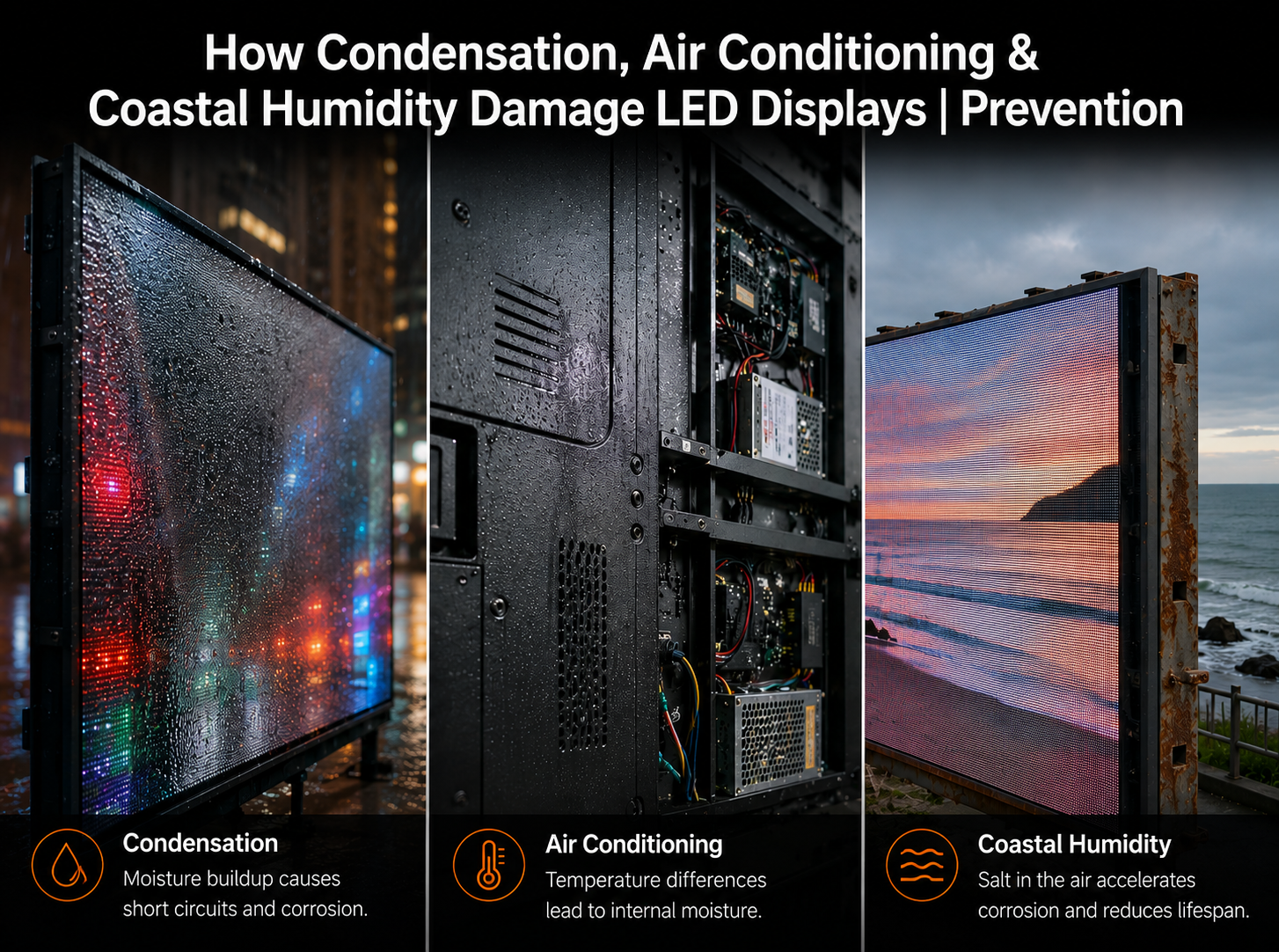
- ▸Coastal and waterfront installations — IP65 or IP66 for ingress protection, but the more critical specification is corrosion resistance. Salt-laden air penetrates even sealed enclosures through condensation and thermal cycling. Marine-grade sealing, conformal-coated PCBs, and stainless steel fasteners are required independently of the IP rating.
For installations in coastal, high-humidity, desert, or extreme temperature environments, the IP rating is a starting point — not the complete specification. Each environment introduces failure modes that IP testing does not address.
Coastal environments — Salt-laden air causes galvanic corrosion on metal components, oxidation on PCB traces, and degradation of rubber seals. Required additional specifications: marine-grade aluminum alloy cabinet, conformal coating on all PCBs, stainless steel hardware, and enhanced gasket materials rated for UV and ozone exposure.
High-humidity tropical environments — Condensation forms inside cabinets during rapid temperature changes, bypassing IP protection through the thermal cycling process rather than direct water ingress. Required: conformal-coated PCBs, silica gel desiccant compartments or active ventilation with humidity control.
Desert and high-dust environments — IP6X (fully dust-tight) is essential. Fine desert sand particles are smaller than the particles used in standard IP dust testing. Verify that the manufacturer has conducted tests with fine silica particles, not just standard talcum powder as specified in the basic IEC standard.
Extreme temperature environments — IP rating does not specify operating temperature range. Always confirm the rated operating temperature range separately. Standard outdoor LED displays typically operate from -20°C to +50°C. Arctic or equatorial installations may require extended range components.
Understanding the limits of IP certification is as important as understanding what it guarantees. Specifiers who rely solely on IP rating to assess outdoor suitability frequently encounter failures that the rating was never designed to prevent.
- ▸UV resistance — IP testing does not include UV exposure. Plastics, rubber gaskets, and certain coatings degrade under prolonged UV exposure regardless of IP rating. Specify UV-stabilised materials separately.
- ▸Corrosion resistance — IP testing uses fresh water. Salt spray resistance, galvanic corrosion protection, and oxidation resistance require separate testing under standards such as IEC 60068-2-52 (salt mist).
- ▸Thermal cycling durability — Repeated expansion and contraction from daily temperature cycles stresses seals and cabinet joints. IP testing is conducted at a single temperature point and does not simulate thermal cycling fatigue.
- ▸Impact resistance — IP testing covers particle ingress only, not physical impact. Impact resistance is covered under IK ratings (IEC 62262), a separate classification system.
- ▸Long-term seal integrity — IP testing is conducted on new enclosures. Rubber gaskets compress and degrade over time. An IP65-rated display will not maintain that rating indefinitely without gasket inspection and replacement as part of a maintenance programme.
IP ratings are self-declared by many manufacturers without independent third-party verification. The number on a datasheet is not always backed by a certified test report. Before accepting any IP rating specification for a permanent outdoor installation, verify it with the following questions.
- ▸"Can you provide the IEC 60529 test report from an accredited laboratory?" — A legitimate IP rating should be backed by a test report from an accredited third-party testing body such as TÜV, SGS, Bureau Veritas, or equivalent. Self-declared ratings without test documentation carry significant risk.
- ▸"Does the IP rating apply to the complete assembled cabinet or only the front module?" — Module-level IP ratings do not account for cable entry points, power box sealing, or rear panel protection. Request confirmation that the full cabinet assembly was tested.
- ▸"What gasket material is used and what is the recommended replacement interval?" — This question reveals whether the manufacturer has engineered for long-term field performance, not just a one-time test pass.
- ▸"Is the power box drainage design included in the IP rating test?" — The power entry and drainage points are the most common ingress failure locations. Confirm they were included in the test configuration.
Before confirming any outdoor LED display order, verify the following:
- ✓ IP rating confirmed for complete assembled cabinet, not front module only
- ✓ IEC 60529 test report from accredited third-party laboratory provided
- ✓ Front and rear IP ratings confirmed separately
- ✓ Power box drainage design included in IP test configuration
- ✓ IP65 front and rear minimum for all freestanding billboard installations
- ✓ Coastal installations: corrosion resistance specification confirmed separately from IP rating
- ✓ Gasket material and replacement interval confirmed with manufacturer
- ✓ Operating temperature range confirmed for installation climate
VMX Visual's outdoor LED display range is IP65 rated across front and rear surfaces as standard, with EU warehouse stock in Belgium, Italy, and France for fast delivery across Europe.
References & Standards
- International Electrotechnical Commission (IEC) — IEC 60529: Degrees of protection provided by enclosures
- TÜV SÜD — IP rating testing and certification services
- IEC 62262 — Degrees of protection provided by enclosures for electrical equipment against external mechanical impacts (IK Code)


Share:
how does the refresh rate of a display impact performance perception during general use?
QC Inspection: Customized White VEGA Series P1.25 Indoor LED Display for France Project