Start Your Project.

Custom LED solutions

Contact Us


XR Studio Orlando, USA VENUS PRO P1.9 Virtual Production Brompton R2

In October 2023, VMX Visual completed the supply and installation of an 18m² VENUS PRO P1.9 LED volume at a virtual production studio in Orlando, Florida. Designed for ICVFX film production, commercial shoots, and live broadcast, this installation demanded specifications that standard LED displays cannot meet — and engineering solutions that go well beyond off-the-shelf components.

01 Technical Solution

Virtual production LED volumes operate under fundamentally different requirements from standard commercial displays. The camera — not the human eye — is the primary viewer, and cinema cameras with high-speed shutters are far more sensitive to display performance than any live audience. Every specification decision for this Orlando installation was made with in-camera VFX quality as the primary criterion.

VMX Visual supplied the VENUS PRO Series P1.9 in a 6m × 3m configuration, covering 18m² of active display area. The VENUS PRO was selected over standard fine pitch panels for four critical engineering advantages: custom LED chip design for high contrast, underfill encapsulation technology for improved black level, Brompton R2 control card integration for ultra-low latency, and a colour specification exceeding DCI-P3 98% for cinema-accurate reproduction.

Contrast ratio was the first engineering priority. Standard LED displays achieve contrast ratios of 3,000:1 to 6,000:1 — insufficient for virtual production where even moderate ambient light from the LED wall must render convincingly in camera without blowout or crush. The VENUS PRO uses custom-designed LED chips with enlarged die size combined with underfill encapsulation technology, achieving a contrast ratio exceeding 10,000:1. This combination maximises black screen depth while increasing peak white brightness simultaneously.

Refresh rate and latency were addressed through the Brompton Tessera R2 control card — the latest generation at the time of this installation. The R2 card delivers a 7,680 Hz refresh rate with significantly reduced frame latency compared to previous generation cards, eliminating the rolling shutter artifacts and temporal lag that compromise ICVFX compositing quality. Low latency is critical for tracking-based virtual production: if the LED wall image updates too slowly relative to camera movement, the perspective shift between the real and virtual environment breaks the illusion on camera.

Colour accuracy was specified at DCI-P3 98% coverage to ensure that LED wall content matches the colour space used in cinema post-production. Colour temperature uniformity and low colour shift across the full display surface are maintained through factory-level calibration and Brompton's per-pixel processing capability.

18m²
LED Volume
7,680
Hz Refresh
10,000:1
Contrast Ratio
DCI-P3
98% Colour
Client Feedback

"Good quality with amazing ICVFX."

Virtual Production Studio — Orlando, Florida, USA

02 Product Specification
Specification Detail
Model VENUS PRO Series — VN-191 PRO
Pixel Pitch 1.9 mm
Display Configuration 6,000 × 3,000 mm (6m × 3m)
Total Display Area 18 m²
Peak Brightness 1,700 nits
Contrast Ratio > 10,000:1 (custom LED + underfill technology)
Refresh Rate 7,680 Hz
Greyscale 16-bit
Colour Gamut DCI-P3 > 98%
Control System Brompton Tessera R2
IP Rating (F/R) IP42 / IP42
LED Technology Custom die-enlarged LED chips with underfill encapsulation
Application ICVFX film production, commercial shoots, live broadcast
Installation Location Orlando, Florida, USA
Completion Date October 2023
Warranty 2-year product warranty (US local), 5-year maintenance support
03 Project Results
  • Cinema-grade ICVFX performance confirmed on camera — The client confirmed "amazing ICVFX" quality on first live production use. 7,680 Hz refresh rate and Brompton R2 latency performance eliminated all rolling shutter artifacts across all camera configurations tested in the studio.
  • 10,000:1 contrast ratio enables convincing environment reproduction — Deep blacks and bright highlights are reproduced simultaneously on the LED wall, allowing cameras to expose for the subject without the background burning out or crushing — a critical requirement for ICVFX compositing.
  • Multi-application versatility across all three production types — The studio successfully operates across film production, commercial shoots, and live broadcast from a single LED volume installation, maximising utilisation and return on investment for the client.
  • 5-year maintenance coverage in the US market — Local warranty and maintenance support eliminates the logistical challenge of cross-border warranty claims, giving the studio operational confidence for long-term production scheduling.
04 Why Standard LED Displays Cannot Be Used for Virtual Production

This is the question most first-time XR studio buyers ask. A standard fine pitch LED display may look visually impressive to a live audience — but when a cinema camera with a high-speed shutter captures it, the limitations become immediately apparent. Virtual production imposes six requirements that standard commercial displays cannot meet:

  • Contrast ratio above 10,000:1 — Standard commercial LED displays achieve 3,000:1 to 6,000:1. At these ratios, dark areas of the background appear grey rather than black on camera — an immediately visible compositing failure. Virtual production requires 10,000:1 or higher to produce convincing deep blacks without gamma correction artefacts.
  • Brightness above 1,500 nits — Cinema cameras expose for the subject, not the background. If the LED wall is not bright enough, the background underexposes and loses detail when the camera iris opens to expose the subject correctly. 1,500 nits is the practical minimum for indoor virtual production; 1,700 nits as specified in this installation provides additional headroom.
  • Refresh rate above 7,680 Hz — Cinema cameras, particularly those shooting at high frame rates or with variable shutter angles, are highly susceptible to LED refresh rate artifacts. Below 7,680 Hz, rolling shutter bands appear in fast-moving content or when the camera pans quickly. These artifacts cannot be removed in post-production.
  • Greyscale of 16-bit minimum — Virtual production content includes subtle lighting gradients, atmospheric effects, and HDR sky environments that require fine greyscale precision to reproduce accurately. 16-bit greyscale provides 65,536 brightness steps. Standard 12-bit or lower displays show visible banding in gradients — immediately apparent in wide, open-sky environments commonly used as virtual backgrounds.
  • DCI-P3 98%+ colour gamut — Cinema post-production operates in the DCI-P3 colour space. An LED wall that cannot cover this gamut will reproduce colours on camera that diverge from the final grade — creating a mismatch between in-camera VFX elements and post-production compositing that requires costly colour correction to address.
  • White balance uniformity and low colour shift — Non-uniform white balance across the LED surface creates uneven lighting on the subject and inconsistent colour cast across different areas of the frame. Low colour shift ensures that whites remain neutral across the full brightness range — critical for skin tone reproduction in close-up work.
05 Challenges & Solutions

This project required engineering solutions across optical, electronic, and logistical domains. Below is a full account of the key challenges encountered and how each was resolved.

01 — Standard LED chips could not achieve the 10,000:1 contrast ratio required for ICVFX

Resolution

VMX Visual specified custom-designed LED chips with an enlarged die size compared to standard commercial LED components. The larger die produces greater peak luminance at equivalent drive current, increasing the white level. Simultaneously, underfill encapsulation technology was applied during module production — filling the space between LED chips with black optical resin that absorbs ambient light and eliminates inter-chip reflections. The combination of increased white brightness and reduced black floor delivers a contrast ratio exceeding 10,000:1, compared to 4,000:1–6,000:1 for standard components.

02 — Frame latency from the control system was introducing tracking misalignment in ICVFX shots

Resolution

In tracking-based virtual production, the LED wall content must update in near real-time as the camera moves — any latency between camera position data and LED wall image update creates a visible parallax error that breaks the illusion on camera. VMX Visual specified the Brompton Tessera R2 processing card, which at the time of this installation represented the latest generation of Brompton's processing platform. The R2 card delivers significantly reduced frame processing latency compared to previous generation cards, eliminating the tracking misalignment that had been observed during pre-installation testing with an alternative control system.

03 — Colour calibration required matching LED wall output to the studio's camera colour pipeline

Resolution

The studio operates with a colour-managed pipeline based on the DCI-P3 colour space. Brompton's Tessera R2 processing includes per-panel and per-pixel colour calibration, allowing the LED wall output to be profiled and corrected to match the DCI-P3 target precisely. VMX Visual's technical team worked with the studio's DIT and colour science team to perform the initial calibration, producing a calibration profile that is applied at the Brompton processing level before signal output reaches the LED panels.

04 — Moiré patterns appeared when shooting with certain lens and aperture combinations

Resolution

Moiré interference between the LED pixel grid and the camera sensor grid is a physics phenomenon that cannot be entirely eliminated through display specification alone. VMX Visual advised the studio's camera team on optimal shooting distances and focal lengths for the P1.9 pixel pitch to minimise moiré visibility. Brompton's processing also includes a sub-pixel dithering function that reduces the visual impact of pixel grid interference at affected focal lengths. The combination of P1.9 pixel pitch and Brompton processing reduced moiré to below the perceptible threshold for the studio's primary production use cases.

05 — Studio required multi-application capability across film, commercial, and broadcast without reconfiguration

Resolution

The VENUS PRO P1.9 specification — 7,680 Hz refresh rate, 1,700 nits, 10,000:1 contrast, DCI-P3 98% colour — meets the requirements of all three production types simultaneously without compromise. Brompton's processing platform supports multiple signal input formats and resolutions, allowing the studio to switch between film production, commercial advertising, and live broadcast configurations through software profile changes rather than any physical hardware reconfiguration.

06 — US-based warranty and maintenance support was required but supplier is China-based

Resolution

VMX Visual arranged a 2-year product warranty with US local fulfilment and a 5-year maintenance support agreement covering the installation. Local spare module stock was established in the US market to support rapid replacement without cross-border shipping delays. For a production studio where LED downtime directly translates to lost revenue from cancelled shoots, local warranty fulfilment is a non-negotiable operational requirement — VMX Visual structured the service agreement accordingly.

07 — Studio team required training on Brompton Tessera R2 system operation

Resolution

VMX Visual conducted a dedicated remote training programme covering Brompton Tessera R2 system configuration, calibration profile management, brightness scheduling, fault diagnostics, and emergency bypass procedures. Training documentation was provided in a format compatible with the studio's existing technical operations team structure. A direct technical support contact was established for ongoing operational queries during the warranty period.

08 — Brightness uniformity across the full 18m² surface was critical for even subject lighting

Resolution

All panels were produced from a single LED batch and pre-calibrated at the factory before shipment. On-site calibration using Brompton's per-pixel correction capability achieved brightness uniformity within ±3% across the full 18m² surface — below the threshold of camera-visible non-uniformity. A calibration schedule was established for every six months of operation to maintain uniformity as individual LEDs age.

09 — Cabinet seam visibility under close-range cinema camera scrutiny

Resolution

Cinema cameras at close range can detect cabinet seams that would be invisible to a live audience. VENUS PRO cabinets were installed with precision alignment tools to achieve flatness tolerance within 0.3mm across the full panel array. Post-installation seam inspection was performed under controlled lighting conditions using the studio's primary production camera before sign-off, confirming seam lines were below the visibility threshold for all intended shooting distances.

10 — Long-term brightness maintenance required for consistent production quality over the 5-year support period

Resolution

The initial brightness specification of 1,700 nits was set above the minimum production threshold of 1,500 nits to provide luminance degradation headroom over the installation's operational life. The 5-year maintenance agreement includes biannual calibration visits and a brightness assessment at each visit, with module replacement triggered when any zone falls below the minimum production threshold. This ensures the studio maintains consistent ICVFX quality standards throughout the support period without unexpected downtime.

Planning an XR Studio or Virtual Production Installation?

Our technical team specialises in LED volume specification for ICVFX, commercial production, and live broadcast. We advise on pixel pitch, contrast, refresh rate, control system selection, and Brompton integration for your specific camera and production requirements.

View XR Studio Range → Get a Quote →
Latest Stories

View all

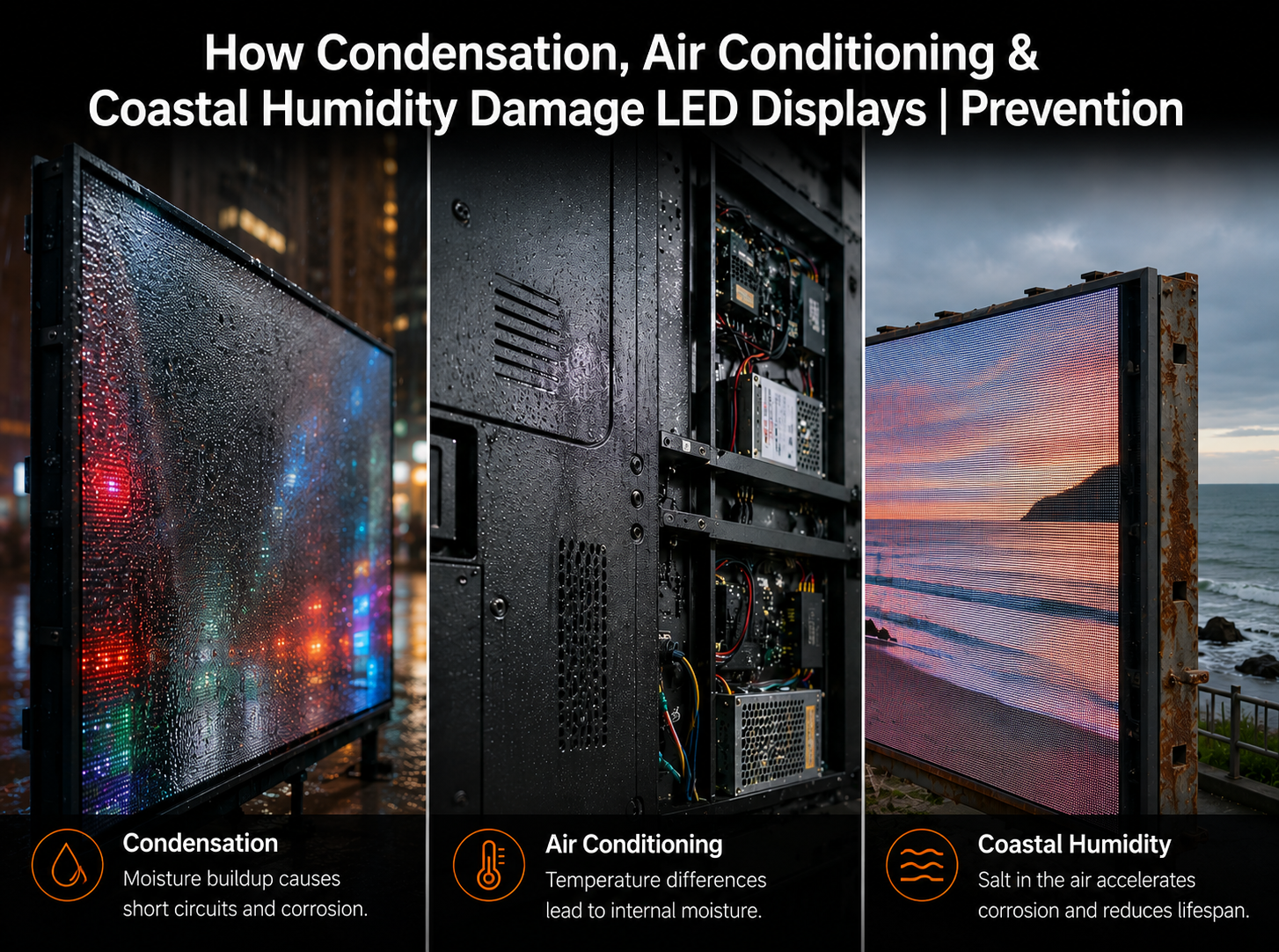
How Condensation, Air Conditioning & Coastal Humidity Damage LED Displays | Prevention Guide
  • by AdminVMX

How Condensation, Air Conditioning & Coastal Humidity Damage LED Displays | Prevention Guide

Learn how condensation, direct air conditioning, humidity, salt mist, static electricity and conductive liquids damage LED displays, and discover practical prevention methods for long-term LED screen reliability.

Read more

Full Flip Chip COB LED Display Explained | COB vs SMD & Flip Chip Advantages
  • by AdminVMX

Full Flip Chip COB LED Display Explained | COB vs SMD & Flip Chip Advantages

Learn everything about COB LED display technology, including COB vs SMD, flip chip vs wire bonding, and the advantages of full flip chip COB for high-end LED displays.

Read more

LED Display Color Distortion Troubleshooting: A Full Diagnostic Guide
  • by AdminVMX

LED Display Color Distortion Troubleshooting: A Full Diagnostic Guide

  Table of Contents01 Why Colour Distortion Happens | 02 Software & Settings | 03 Cable & Connection Faults | 04 Ambient Lighting | 05 Camera Colour Problems | 06 Hardware Failures | 07 LED Ageing & Calibration | 08...

Read more

The Hidden Cost of "Cheap" LED Displays: Power Consumption & Maintenance
  • by AdminVMX

The Hidden Cost of "Cheap" LED Displays: Power Consumption & Maintenance

Buying a cheap LED display is a hidden debt. High power bills and frequent repairs can cost you 200% more over 5 years. Check our 5-year TCO analysis to quantify electricity, downtime, and maintenance costs before you invest. Case included.

Read more

US Warehouse Logistics: VG-181 (P1.86) Passed Final QC & Ready for Dispatch
  • by AdminVMX

US Warehouse Logistics: VG-181 (P1.86) Passed Final QC & Ready for Dispatch

VMX Visual successfully completed the QC and dispatch of the VG-181 (P1.86) series from our USA warehouse. These UHD indoor displays passed 72H aging and RGB precision tests.

Read more

QC Inspection:100PCS VEGA Series Smart Pole LEDs Headed to New Urban Landmark
  • by AdminVMX

QC Inspection:100PCS VEGA Series Smart Pole LEDs Headed to New Urban Landmark

VMX Visual dispatched 100 VEGA P6 Pole LEDs with 7000nits and IP65 rating. Features Delight LEDs, zero-defect aging test, and a 5-year warranty. Fast delivery available via Belgium warehouse.

Read more

Bespoke VMX VEGA Series P1.25 indoor LED video wall displaying ultra-HD 4K content for a luxury project in France.
  • by AdminVMX

How Much Does an Indoor P1.25 LED Video Wall Cost in 2026? (Hidden Costs Revealed)

  Table of Contents01 What Drives the Price | 02 Panel Cost Breakdown | 03 Hidden Costs | 04 Installation Costs | 05 Ongoing Costs | 06 Factory-Direct vs Distributor | 07 Why Quotes Differ So Much | 08 How...

Read more

QC Inspection: Customized White VEGA Series P1.25 Indoor LED Display for France Project
  • by AdminVMX

QC Inspection: Customized White VEGA Series P1.25 Indoor LED Display for France Project

QC Log: Bespoke White VEGA P1.25 Indoor LED for France Project. Features ultra-HD 4K resolution, 72-hour aging, and RGB purity tests. Designed for seamless European high-end integration with precision die-casting aluminum engineering.

Read more

What IP Rating Does an Outdoor LED Display Actually Need?
  • by AdminVMX

What IP Rating Does an Outdoor LED Display Actually Need?

  Table of Contents 01 What Is IP Rating 05 IP Rating by Application 02 Reading the Two-Digit Code 06 Coastal & Extreme Environments 03 Common IP Ratings Explained 07 What IP Rating Does Not Cover 04 Front vs Rear...

Read more

how does the refresh rate of a display impact performance perception during general use?
  • by AdminVMX

how does the refresh rate of a display impact performance perception during general use?

What refresh rate does your LED display actually need? Covers human perception thresholds, broadcast camera requirements, greyscale accuracy and how to verify supplier specs.

Read more

Stories Behind the Screens: VMX Visual at ISLE 2026
  • by AdminVMX

Stories Behind the Screens: VMX Visual at ISLE 2026

Day 2 at ISLE 2026 brought energy, ideas, and meaningful connections for the VMX Visual team. From stage rental to virtual production, we sat down with clients and industry peers from around the world to talk about what's next in LED display technology — and the experiences we're building together.

Read more

How to Choose Concert Stage LED Screens: Pixel Pitch, Weight & Brightness Explained
  • by AdminVMX

How to Choose Concert Stage LED Screens: Pixel Pitch, Weight & Brightness Explained

  Table of Contents01 Pixel Pitch | 02 Cabinet Weight | 03 Brightness | 04 Refresh Rate | 05 IP Rating | 06 Assembly Speed | 07 Control Systems | 08 Indoor vs Outdoor | ✓ Stage LED Checklist The...

Read more