
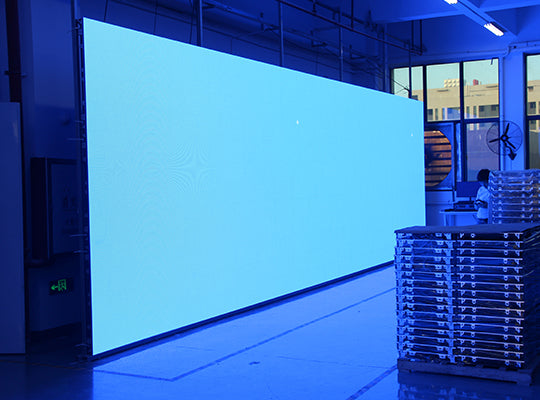
As a professional LED display manufacturer, we know that a successful project is built on precision engineering, not guesswork. From calculating the optimal viewing distance to determining the exact power load and cable thickness, every detail matters for system stability and safety.
Article Navigation (Quick Jump)
- 1. How to Determine Pixel Pitch & Viewing Distance
- 2. How to Calculate Module Resolution & Dimensions
- 3. How to Calculate Receiving Cards & Processor Ports
- 4. How to Determine Screen Sizing & Aspect Ratios
- 5. How to Configure Power Supplies for Stability
- 6. How to Size Main Power Cables & Distribution
- 7. Expert Summary: Why Precision Matters
1. How to Determine Pixel Pitch & Viewing Distance
The first step in any LED project is selecting the correct Pixel Pitch (P). According to AVIXA, the goal is to provide a seamless visual experience where the human eye cannot distinguish individual pixels.
Minimum Suitable Distance = Pixel Pitch (mm) × 1,000
Example: For a P1.5 display, the optimal viewing range is 1.5m to 4.5m.
2. How to Calculate Module Resolution & Dimensions
To design your content and control system, you must know the exact pixel count per module.
Module Width Dots = Module Width (mm) ÷ Pixel Pitch (mm)
Example (P2 Module 320x160mm): Length dots = 320 ÷ 2 = 160 pixels. Width dots = 160 ÷ 2 = 80 pixels.
3. How to Calculate Receiving Cards & Processor Ports
A stable signal depends on never overloading your hardware. Following IPC standards, we recommend a safety margin.
A. Receiving Card Count
Total Cards = (Modules Wide ÷ Card Load Width) × (Modules High ÷ Card Load Height)
B. Network Port Loads
Each standard Gigabit Ethernet port handles approximately 650,000 pixels. If your screen resolution exceeds this, you must split the load across multiple ports.
4. How to Determine Screen Sizing & Aspect Ratios
Most content is produced in 16:9. To find the ideal dimensions for a targeted area (e.g., 100m²):
Screen Width (B) ≈ 0.75 × √Area
For 100m², the length would be approximately 13.33m and the width 7.5m.
5. How to Configure Power Supplies for Maximum Stability
In our factory, we follow the "78% Stability Rule." Power supplies should never operate at 100% capacity to prevent overheating.
Expert Insight: Components running at 70-80% load will last 5-10 years, whereas those at 100% load often fail within 12 months.
6. How to Size Main Power Cables & Distribution Loads
When the total current exceeds 30A, you must use Three-Phase Power to balance the load, as per IEC standards.
Case Study: P8 Outdoor Screen (1500 Modules)
- Max Power: 1500 × 28W = 42,000W
- Distribution Power: 42,000 ÷ 0.78 ÷ 0.85 ≈ 63,349W
- Total Current: 63,349W ÷ 220V ≈ 288A
- Three-Phase Current: 288A ÷ 3 = 96A per phase.
- Requirement: Match to NFPA 70 standards. A 35mm² copper cable is required.
7. Expert Summary: Why Precision Engineering Matters
Precision in calculation is the signature of a professional project. By applying these systematic formulas, you ensure:
- Safety: No melted cables or fire hazards.
- Visual Quality: No flickering or signal drops due to port saturation.
- Longevity: Optimized power loads for 10-year reliability.
Ready to start your next LED project?
Precision starts at the design phase. Contact our technical team today for a free System Configuration Audit based on your specific project requirements!


Share:
Where Quality Begins: A Deep Dive into the Engineering of Mars & Ceres Series
VMX Visual Heading to ISE 2026: Elevating European Projects with Outdoor Micro-pitch Innovation