

LED displays represent a massive capital investment for any business, ranging from high-end retail environments to massive outdoor digital billboards. However, a dangerous misconception persists among project owners: the belief that a high IP (Ingress Protection) rating for waterproofing automatically translates to complete safety in humid environments. At VMX Visual, our eighteen years of engineering experience have taught us a different, more complex reality: Waterproofing and Moisture-proofing are two entirely distinct physical battles. While waterproofing acts as a barrier against liquid water—the "footballs" of the water world—moisture-proofing is a war against gaseous water molecules, which are small enough to infiltrate the very heart of the electronic circuitry where liquid water cannot reach.
1. Molecular Science: Why Vapor Bypasses Waterproofing
To truly understand why moisture is the "silent killer" of LEDs, we must look at the microscopic physics involved. Water vapor molecules have a kinetic diameter of approximately 0.28 nanometers. In contrast, the materials used to encapsulate LED lamps, primarily epoxy resins and silicones, possess a molecular lattice that is porous on a nanoscopic scale. This means that while your IP65-rated gaskets are perfectly capable of stopping a 100-millimeter raindrop, they are virtually transparent to gaseous water vapor. Over time, humidity flows through these materials like air through a screen door.
Once inside, the moisture initiates Electrochemical Migration (ECM). When voltage is applied to a damp circuit board, metal ions (typically Copper, Silver, or Gold) dissolve into the micro-film of water and migrate from the anode to the cathode. This process creates microscopic metallic "trees" called Dendrites. As these dendrites grow across the insulating gaps between circuits, they cause catastrophic short circuits. On your screen, this manifests as flickering, chromatic aberrations, or the dreaded "Caterpillar Effect"—rows of pixels that glow uncontrollably. If not addressed through thermal dehumidification, these dendrites will permanently etch into the PCB, rendering the module unrepairable.
This is why moisture-proofing is not a feature but a fundamental requirement for 10-year reliability. At VMX, we focus on the "Equilibrium Moisture Content" (EMC) of the materials, ensuring that our internal micro-environments remain stable regardless of the external storm surge or monsoon conditions.
2. Production Secrets: The Triple-Proofing Standard (IPC-A-610)
Reliability must be engineered into the product before it ever reaches the job site. At the VMX VISUAL factory, we adhere to the IPC-A-610 (Acceptability of Electronic Assemblies) standard, which dictates how sensitive electronics must be protected. Our primary defense is the application of Conformal Coating, often known in the industry as "Triple-Proof Paint"—protecting against moisture, mold, and salt spray.
Not all coatings are equal. We utilize a high-grade, polyurethane-based coating that maintains a flexible bond across extreme temperature ranges from -40°C up to +80°C. If a coating is too brittle, it will develop micro-cracks during the natural thermal expansion and contraction of the LED screen, allowing vapor to seep in. We apply this coating with a precision automated spray system, ensuring every IC pin and solder pad is isolated from the atmosphere. Additionally, we use hollow-core bubble gaskets. Unlike traditional flat rubber seals, these gaskets compress to form a vacuum-like hermetic seal, preventing the cabinet from "breathing" in moist air during nighttime cooling cycles. Every VMX VISUAL cabinet is a fortress against the microscopic world of vapor.
3. Warehouse Logistics: Controlling the MSL Environment
Many LED displays are ruined before they are even unboxed, simply because they were stored incorrectly in a humid warehouse. In the semiconductor industry, LEDs and driver ICs are classified as Moisture Sensitive Devices (MSD). We manage our global logistics according to the J-STD-033 standard, which treats every LED module with the same care as a silicon wafer.
1. Elevation and Palletization: Never store LED boxes directly on concrete. Concrete is a porous material that draws moisture from the ground and releases it into the air. All VMX inventory must be kept on plastic or wooden pallets at least 20cm off the floor.
2. Atmospheric Monitoring: Every warehouse must be equipped with digital hygrometers and automated logging. If ambient humidity exceeds 60% RH, industrial-grade dehumidifiers must be activated immediately to bring the environment back to a safe range.
3. The "Second Floor" Rule: Since cold, moist air is denser and settles near the ground, we recommend storing sensitive LED components on the second floor or higher. This simple strategy can reduce moisture exposure by up to 25% without additional energy costs.
If a vacuum-sealed bag is punctured during transit, the module must be "baked" at a low, controlled temperature to remove latent moisture before it can be soldered or powered on. This prevents the "Popcorn Effect," where moisture trapped inside a component expands into steam during heating, causing the device to rupture internally.
4. The Installation Trap: Construction Vapor & Renovation
One of the most frequent causes of early-life screen failure is what we call the "Renovation Trap." Many project managers install beautiful LED video walls while the rest of the building is still under construction. This is a recipe for disaster. Materials like wet paint, fresh plaster, and newly poured cement release immense volumes of water vapor as they cure. If an LED screen is installed in this "steam room" and left without power, it will act like a giant sponge, absorbing vapor into its driver ICs and LED lamp beads.
Ideally, installation should be the final phase of a building project. However, if schedules overlap, the screen must be protected. We mandate that the screen be fully covered with a heavy-duty, breathable tarp to block dust, while simultaneously being powered on for at least 2 hours every day. This operation uses the screen's own waste heat to "sweat out" the moisture being released by the surrounding construction work. Never assume a screen is safe just because it is turned off.
5. Operational Dehumidification: The Self-Heating Remedy
As the old saying in the industry goes, "A working screen is a dry screen." Heat is the ultimate natural remedy for moisture. When an LED screen is operational, the internal components generate a thermal field that naturally evaporates any trace of vapor and pushes it out through the cabinet's ventilation system. However, the way you turn on a screen after a period of humidity is critical.
The VMX 6-Hour Gradual Ramp-Up Schedule:
| Phase | Brightness | Duration | Engineering Objective |
|---|---|---|---|
| Pre-Heat | Power On (Black Signal) | 2 Hours | Warm the driver ICs and power supplies gently. |
| Stage 1 | 30% Brightness | 2 Hours | Gently evaporate surface moisture and mask condensation. |
| Stage 2 | 60% Brightness | 2 Hours | Deep-bake the PCB layers to remove molecular vapor. |
| Stage 3 | 100% Brightness | Normal Use | Maintain a stable, dry thermal equilibrium. |
Following this simple schedule can extend the life of your display by years and prevents the localized short circuits that lead to chromatic drift and flickering.
6. Global Climates: Coastal, Monsoon, and Indoor Challenges
Environmental management is not "one size fits all." At VMX, we adjust our structural designs based on the specific geography of the installation.
Coastal and High-Salinity Zones
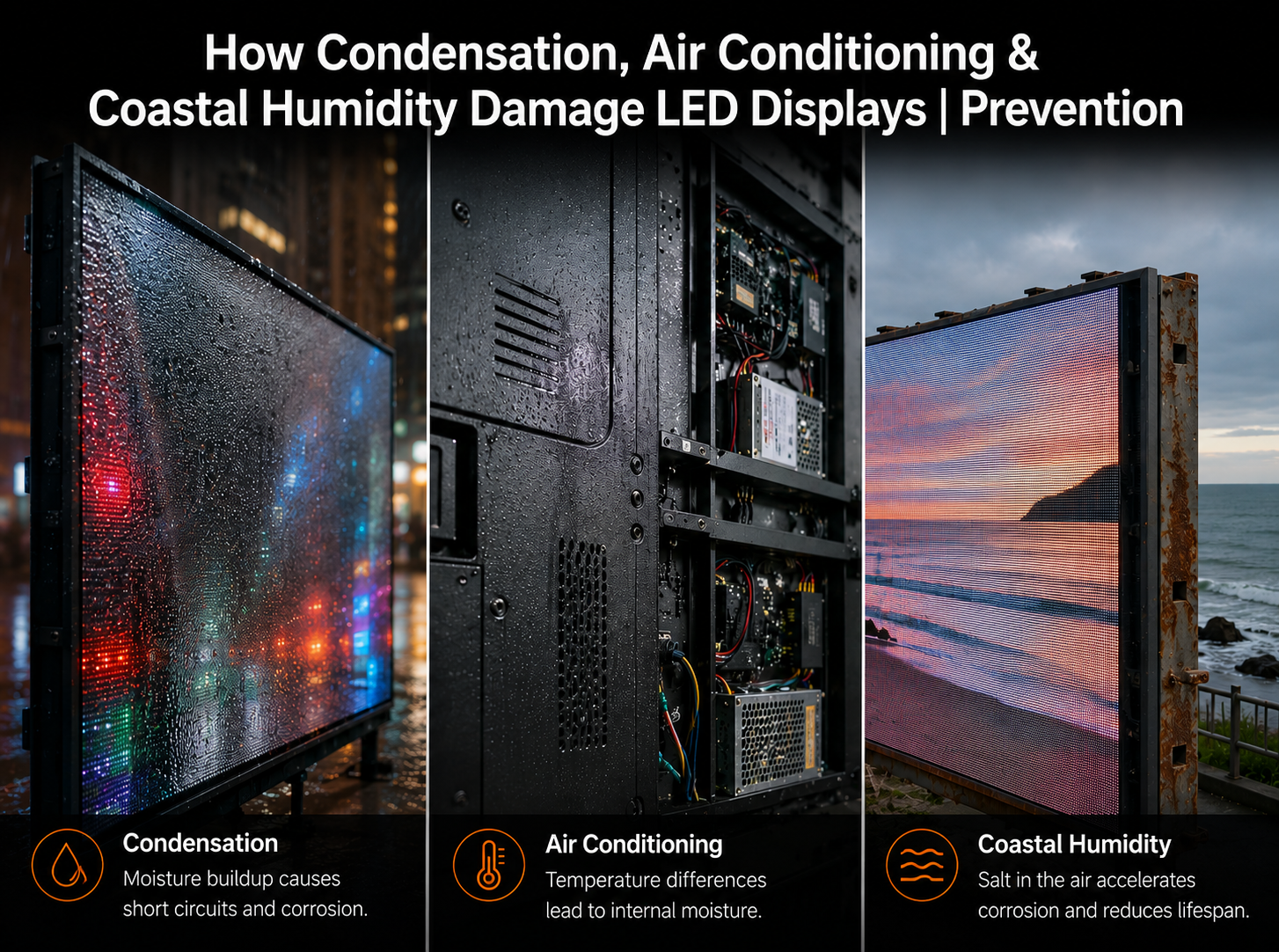
Salt is hygroscopic, meaning it acts as a magnet for water. In coastal cities like Miami, Dubai, or Singapore, salt particles in the air hold moisture against the screen's electronics even on sunny days. This creates a corrosive "brine" that accelerates the ECM process. For these environments, we specify a "closed-loop" cooling system where internal air is never exchanged with the salty outdoor atmosphere, using internal heat exchangers instead.
The Indoor "Dew Point" Trap
In high-end offices, the most common enemy is the Air Conditioning system. If an AC vent blows cold air directly onto a warm LED screen, the surface temperature can drop below the Dew Point. This causes moisture in the air to condense into liquid "sweat" on the modules. This dew can seep between pixels, causing instant short circuits. We always advise clients to ensure AC vents are angled away from the screen and that the indoor humidity is kept below 65% RH at all times.
7. Emergency Recovery: The 5-Day Resurrection Protocol
If a roof leaks, a pipe bursts, or your screen is accidentally sprayed with water, your actions in the first 24 "Golden Hours" will determine if the asset can be saved. Step One: Immediately cut the main power breaker. Do not use the software "Off" button; you must isolate the screen from the electrical grid entirely.
1. Cool Air Circulation: Open the back of the cabinets and use industrial fans to circulate room-temperature air. WARNING: Never use heat guns or hair dryers. High, localized heat will cause the water trapped between the PCB layers to boil, leading to "delamination" (the board peeling apart), which is unrepairable. Cool air is the only safe path for deep evaporation.
2. The Resurrection Schedule: Once the screen appears dry, begin a 5-day ramp-up: Day 1 (10% brightness), Day 2 (30%), Day 3 (60%), Day 4 (80%), Day 5 (100%). Monitor the screen for any smells of ozone or scorched electronics. If a module fails during this process, replace it immediately to prevent it from damaging its neighbors.
8. Final Maintenance Checklist for a 10-Year Asset
Long-term reliability is a habit, not a feature. To ensure your LED display survives its 100,000-hour design life, follow this VMX engineering checklist every quarter:
- Seal Integrity: Inspect all rubber gaskets for UV cracking or hardening. Apply silicone lubricant to keep them supple if necessary.
- Drainage Path: Ensure the weep holes and drainage channels at the bottom of the cabinets are free of dust, construction debris, or bird nests.
- Dust Removal: Dust is a sponge for moisture. Use compressed air to clean out power supplies and cooling fans every 6 months to ensure the system can "breathe" and stay dry.
- Operational Record: Keep a log of ambient humidity. If the average humidity in the room is rising over time, it may indicate a failure in the building's HVAC system that will eventually harm the screen.
Treat your LED display with the same precision with which it was engineered. By respecting the science of humidity, you transform a fragile piece of technology into a robust, 10-year financial engine for your brand. Prevention through proper engineering, disciplined storage, and gradual de-humidification is always cheaper than a catastrophic repair.
Ready for a Technical Reliability Audit?
Our VMX engineering team is ready to review your project's moisture protection plan. Don't wait for the rainy season to test your hardware.
Consult with Our Technical Team


Share:
VMX Visual at ISE Barcelona: Showcasing the Future of Micro LED & Creative Engineering
VMX Visual at ISE 2026: Meet Our Leadership Team in Barcelona at Booth 3K700