Table of Contents
01 Pixel Pitch | 02 Cabinet Weight | 03 Brightness | 04 Refresh Rate | 05 IP Rating | 06 Assembly Speed | 07 Control Systems | 08 Indoor vs Outdoor | ✓ Stage LED Checklist
The wrong LED panels will cost you more than money. They'll cost you load-in time, crew hours, and audience experience. This guide covers the eight technical decisions that separate a smooth production from one that keeps you up the night before show day.
Pixel pitch is the distance in millimetres between the centre of one LED cluster and the next. It determines how sharp the image looks at a given viewing distance — and it's the single most important specification you'll set for any stage production.
The rule is simple: minimum comfortable viewing distance (metres) = pixel pitch (mm) × 1,000. A P2.6 panel should be viewed from at least 2.6 metres. A P3.9 panel from 3.9 metres or beyond.
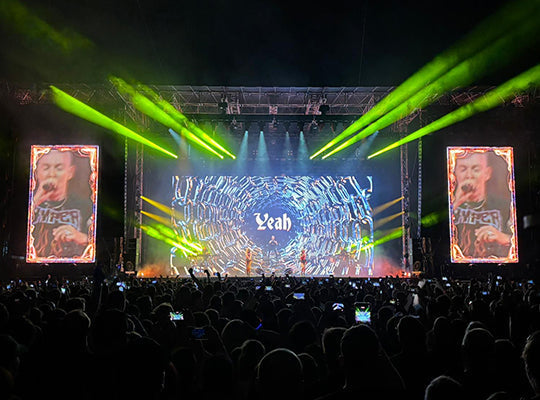
For concert stage rental LED applications, the standard range is P2.6 to P3.9. Here's how to decide:
- ▸P2.6 — Theatre productions, corporate events, and intimate venues where the front row is within 5–8 metres of the screen. Fine enough for close scrutiny, heavier per cabinet.
- ▸P3.9 — The industry workhorse for festivals and large-scale concerts. Lighter cabinets, faster assembly, lower cost per square metre. Audience typically 10–40 metres from the screen.
-
▸P4.8 and above — Large outdoor festivals where the audience is predominantly 30 metres or more from the stage. Rarely used for main stage IMAG screens due to visible pixel structure at moderate distances.

Always spec pixel pitch based on your closest audience member, not the average viewing distance. One person in the front row seeing individual pixels is one complaint too many.
Weight is a logistics problem that becomes a safety problem if ignored. Every kilogram you hang on a truss has to be accounted for in your structural load calculations, and weight directly affects crew fatigue during load-in and load-out.
Professional stage rental cabinets range from 5.5 kg to 10 kg per cabinet. At first glance, the difference seems small. But a 6m × 4m screen using 500×500mm cabinets requires 96 cabinets. The difference between a 6 kg and an 8 kg cabinet is 192 kg on your total truss load — enough to push some rigging configurations beyond safe limits. VMX Visual's VENUS-TOURING II Series is engineered specifically to address this — lightweight cabinet construction without compromising structural integrity.
- ▸Lightweight touring panels (≤ 6.5 kg) — Designed for frequent transport and fast rigging. Typically use magnesium alloy or carbon fibre reinforced frames. Higher upfront cost but lower long-term logistics cost.
- ▸Standard rental panels (7–9 kg) — Die-cast aluminium frames. More durable for rough handling but require more crew time and stronger rigging points.
Always request the weight per cabinet and weight per m² from your supplier — not just the total system weight. Your rigging engineer needs per-m² load data to sign off on the structural design.
Brightness is measured in candelas per square metre (cd/m²), commonly called nits. The right brightness depends entirely on your venue's ambient light conditions.
- ▸Dark indoor venues: 800–1,200 cd/m² — Anything above this in a dark venue will cause eye fatigue for the front rows and wash out the image contrast.
- ▸Ambient indoor venues (warehouses, arenas with skylights): 1,200–2,500 cd/m²
- ▸Outdoor day shows and festivals: 5,000–6,500 cd/m² minimum for visibility in direct sunlight.
Ask for the photometric test report at rated drive current, not the peak specification. Some manufacturers drive panels beyond rated current to inflate brightness figures — this shortens LED lifespan significantly and voids most warranties. For a full breakdown of what quality documentation to request from any supplier, see our LED Display Quality Evaluation Guide.
Refresh rate is the number of times per second the LED panel redraws the image. For live audiences, a refresh rate above 1,920 Hz is generally invisible to the human eye. But for broadcast cameras and IMAG systems, refresh rate is critical.
When a camera's shutter speed doesn't synchronise with the panel's refresh rate, the result is a visible horizontal rolling band — a dark stripe that moves up or down the screen during filming. On a major concert broadcast, this is a serious production problem.
The professional standard for broadcast-compatible stage LED is ≥ 3,840 Hz. For productions with high-speed cameras capturing slow-motion content, panels with ≥ 7,680 Hz refresh rate are recommended. VMX Visual's POLARIS Series meets broadcast refresh rate requirements for both standard and high-frame-rate camera applications.
Always confirm refresh rate with your supplier and test with your specific camera setup before the show day. A 30-minute camera test during load-in has saved many productions from broadcast disasters.
IP (Ingress Protection) rating defines how well a panel resists dust and water. The first digit (1–6) is dust protection, the second digit (1–8) is water protection. IP65 means fully dust-tight and protected against water jets from any direction.
- ▸Indoor venues: IP30–IP40 is sufficient. No weather exposure means no need to pay for weatherproofing you won't use.
- ▸Covered outdoor stages: IP54 minimum — protection against splashing water and dust ingress.
- ▸Fully exposed outdoor stages and festivals: IP65 minimum. If you're in a coastal location or high-rainfall region, consider IP66. VMX Visual's outdoor LED display range is rated IP65 as standard across all models.
One note on IP ratings and weight: higher IP ratings typically mean heavier cabinets due to additional sealing and gasket materials. If you're using outdoor-rated panels for an indoor show to save on inventory management, factor in the additional truss load.
On a festival site with a 4-hour changeover between acts, assembly speed is as important as image quality. A panel system that requires two people and 8 minutes per cabinet is a liability. A system that one person can lock into place in under 2 minutes changes your entire crew structure.
Key assembly features to evaluate:
- ▸Quick-lock mechanism — Tool-free locking between cabinets. The best systems use a single-handed lever that clicks and locks without tools. The VENUS-LITE Series features a single-action quick-lock system designed specifically for fast festival turnarounds.
- ▸Front-serviceable modules — If an LED module fails during a show, can your crew replace it from the front without dismantling the entire structure? Front serviceability is non-negotiable for live event applications.
- ▸Flying bracket compatibility — Check that the cabinet's hanging points are compatible with your standard truss hardware. Non-standard brackets create compatibility headaches across different rental inventory.
-
▸Stacking base compatibility — For ground-supported configurations, confirm the stacking base is included and rated for the height of stack you're planning.

An LED panel is only as good as the control system driving it. The two most widely used processors in the live events industry are NovaStar and Colorlight. Both are compatible with most professional stage rental panels, but each has strengths in different contexts.
- ▸NovaStar — Industry standard for large-format live events. Excellent redundancy options, wide compatibility with video servers and media servers. Recommended for broadcast productions and touring shows with complex signal chains.
- ▸Colorlight — Cost-effective for straightforward applications. Good colour calibration tools, easier setup for smaller productions.
Before ordering panels, confirm which control system your LED operator is certified on. Switching control systems mid-project adds unnecessary complexity and cost. The panel and the processor need to be specified together, not separately. If you have questions about control system compatibility, our FAQ page covers the most common configuration questions.
This is one of the most common questions rental companies face when building their inventory. The short answer: outdoor panels can be used indoors, but indoor panels cannot be used outdoors. The longer answer is more nuanced.
Using outdoor-rated panels (IP65, 5,000+ nits) for indoor shows works technically, but creates three problems:
- ▸Excess brightness — At full output, 5,000 nit panels in a dark venue are uncomfortably bright for the front rows. You'll run them at 15–20% output, which reduces colour accuracy and grey-scale performance.
- ▸Higher weight — Outdoor panels are heavier due to weatherproofing. Your crew and rigging budget absorb that cost on every indoor show.
- ▸Higher cost per m² — You're paying for weatherproofing you don't need on indoor shows.
For rental companies doing a mix of indoor and outdoor events, the most cost-effective approach is a dedicated indoor inventory (P2.6–P3.9, IP40, 1,000–1,500 nits) and a separate outdoor LED display inventory (P3.9–P4.8, IP65, 5,000+ nits). The dual-inventory model has higher upfront capital cost but lower total cost of ownership across a full year of events. Contact our team via the Get a Quote page to discuss the right inventory mix for your event schedule.
Before confirming your panel order or rental agreement, verify the following with your supplier:
- ✓ Pixel pitch matches your closest viewing distance (pitch mm × 1,000 = min viewing distance in metres)
- ✓ Cabinet weight per m² confirmed with rigging engineer
- ✓ Brightness photometric test report at rated drive current (not peak spec)
- ✓ Refresh rate ≥ 3,840 Hz confirmed for broadcast compatibility
- ✓ IP rating appropriate for venue type (IP40 indoor / IP65 outdoor minimum)
- ✓ Front-serviceable LED modules confirmed
- ✓ Quick-lock assembly mechanism tested by crew before show day
- ✓ Control system confirmed compatible with your LED operator's certification
- ✓ Factory aging test records available for your specific production batch
- ✓ CE / FCC / UL certifications available for your market
VMX Visual's stage rental range covers P2.6 to P3.9, with EU warehouse stock in Belgium, Italy, and France for zero lead-time delivery across Europe.
References & Standards
- International Electrotechnical Commission (IEC) — LED display measurement and IP rating standards
- AVIXA — Audiovisual display and brightness specification standards
- NovaStar — LED display control system specifications





Share:
Join VMX Visual for an Exclusive Factory Experience Before ISLE 2026
Stories Behind the Screens: VMX Visual at ISLE 2026