In the professional AV and architectural integration sector, the structural engineering of an LED display system is its most critical—yet most frequently overlooked—component. An LED display is not just a digital surface; it is a heavy active electrical load and a massive physical weight. Its supporting structure acts as the bridge between a brilliant visual asset and a catastrophic liability.
At VMX Visual, our engineering philosophy is built on 18 years of technical excellence. We believe that precision engineering is the foundation of ROI. This 2,250-word guide serves as the industry’s master reference for structural mechanics, thermal physics, electrical integrity, and maintenance accessibility, fully aligned with 2026 international building codes.
Table of Contents
- 1. Mechanics of Load-Bearing: Static, Dynamic & Seismic Forces
- 2. Thermal Dynamics & CFD Simulation: The Physics of Airflow
- 3. Electrical Integrity: Equipotential Grounding & Lightning Safety
- 4. Environmental Material Science: Anti-Corrosion Standards
- 5. Accessibility Engineering: The Maintenance-First Design
- 6. Intelligent Structural Monitoring: IoT & Digital Twins
- 7. Regulatory Compliance & Global Standards Checklist
1. Mechanics of Load-Bearing: Static, Dynamic, and Seismic Forces
Designing a rack is simple; engineering a structural system that survives a 50-year storm requires rigorous physics. In LED engineering, we categorize forces into three distinct vectors that determine the thickness of steel and the grade of fasteners used.
A. Static Vertical Loads (Dead Loads)
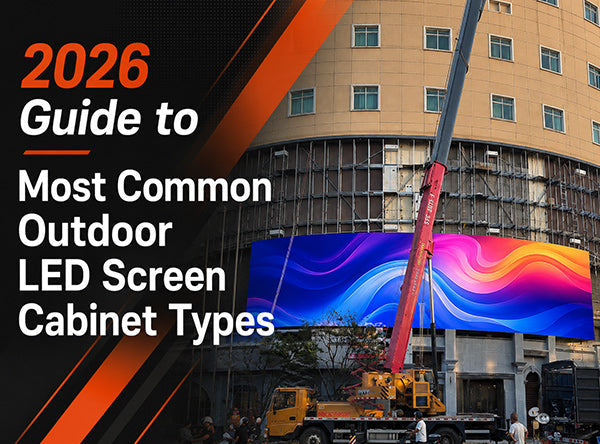
Every square meter of an LED display exerts a downward force. Indoor fine-pitch modules (P0.9–P1.5) generally weigh between 35kg and 60kg/m². Outdoor iron cabinets with high-brightness components can reach 120kg/m². When designing for rooftops, the Dead Load must be calculated in conjunction with Snow Loads, as defined by the IBC Section 1608.
B. Dynamic Wind Pressure (Live Loads)
For outdoor billboards, wind is the "Silent Crusher." A screen acts as a giant sail. According to the ASCE 7-22 Standards, wind pressure increases exponentially with height and local terrain category. In hurricane-prone regions, structures must be rated for 150mph (240km/h) gusts. We utilize high-strength bolts (Grade 10.9) to ensure vibration-induced fatigue does not compromise primary nodes.
C. Seismic Resilience
In active tectonic zones (California, Japan, Chile), the structure must be "flexible yet firm." We incorporate seismic bracing that allows for controlled micro-displacement, preventing the brittle failure of steel members during an earthquake. This follows the Eurocode 8 guidelines for earthquake-resistant design.
2. Thermal Dynamics & CFD Simulation: The Physics of Airflow
Heat is the primary cause of LED lifespan degradation. At VMX Visual, we don't just "add fans"; we use Computational Fluid Dynamics (CFD) to simulate airflow before a single bolt is turned. This ensures that the "Junction Temperature" of the LED chips remains within optimal limits.
According to the IES (Illuminating Engineering Society), for every 10°C increase in operating temperature, the lumen maintenance of the LED lamp decreases significantly. Our active cooling logic uses PLC units to ramp fan speeds based on real-time sensors: Start at 50°C, Full Power at 65°C, and Auto-Dimming at 75°C.
3. Electrical Integrity: Equipotential Grounding & Lightning Safety
An outdoor LED structure is effectively a massive lightning magnet. Without advanced electrical engineering, a single strike can destroy $500,000 worth of electronics in milliseconds.
The Faraday Cage Principle
We design our steel structures to act as part of a protective Faraday Cage. Following NFPA 780 Standards, we implement:
- Equipotential Bonding: Ensuring the screen cabinet, the steel frame, and the building's main ground are all at the same electrical potential to prevent "side-flashing."
- Surge Protection Devices (SPD): Type 1 and Type 2 SPDs are mandatory at the main distribution board and the local cabinet level.
- Grounding Resistance: We aim for a resistance of <4 Ohms to ensure rapid dissipation of surge energy.
4. Environmental Material Science: Anti-Corrosion Standards
The choice of materials determines whether a screen lasts 2 years or 20 years. We specify materials based on the ISO 12944 Corrosion Categories.
- Hot-Dip Galvanization (HDG): For C4/C5 environments (Coastal), we require a minimum zinc coating of 85 microns. HDG provides "sacrificial protection" where the zinc corrodes instead of the structural steel.
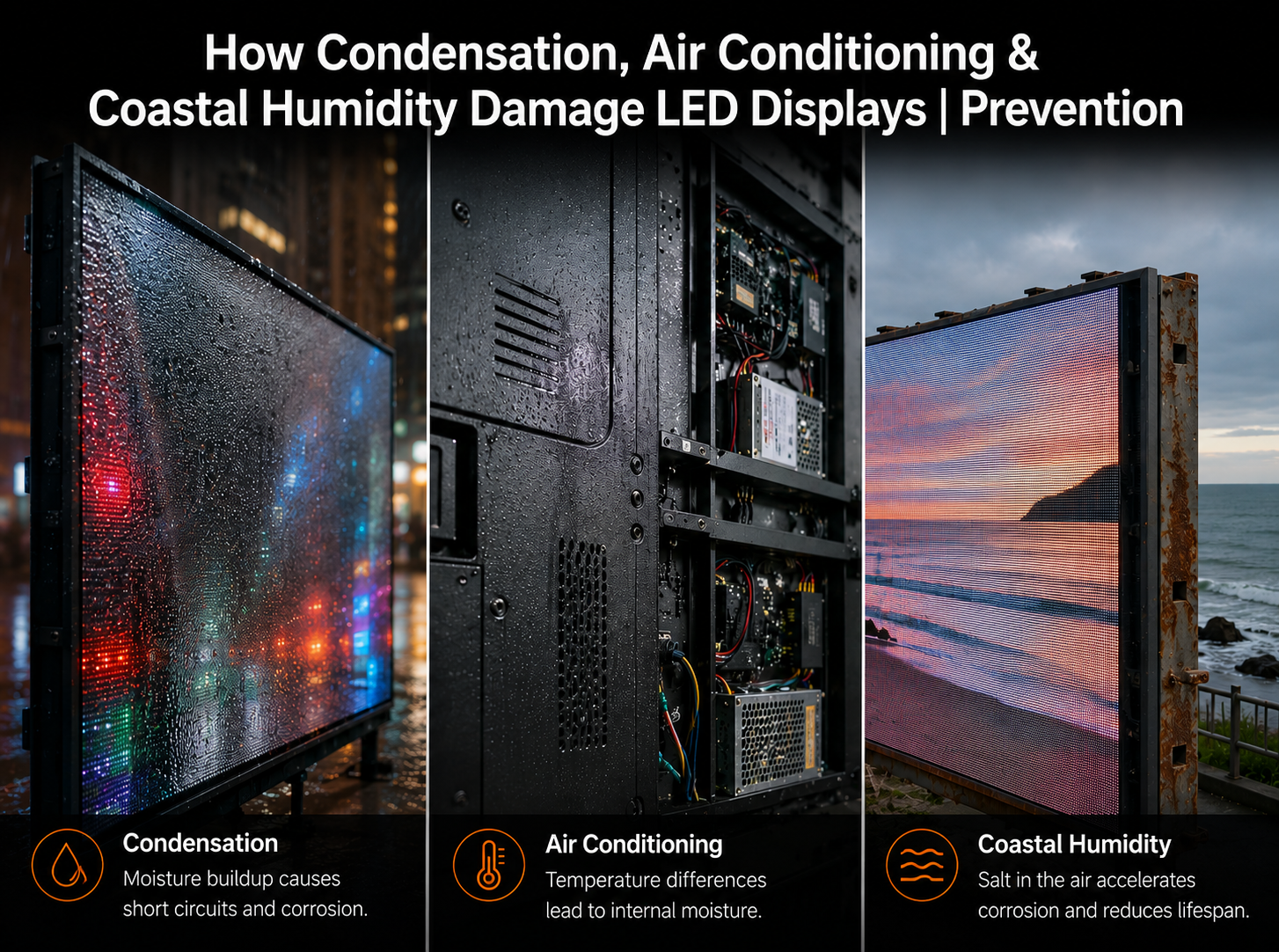
- Bi-Metallic Isolation: When connecting aluminum cabinets to steel frames, we use stainless steel isolation shims to prevent Galvanic Corrosion, a common cause of structural weakening in humid climates.
5. Accessibility Engineering: The Maintenance-First Design
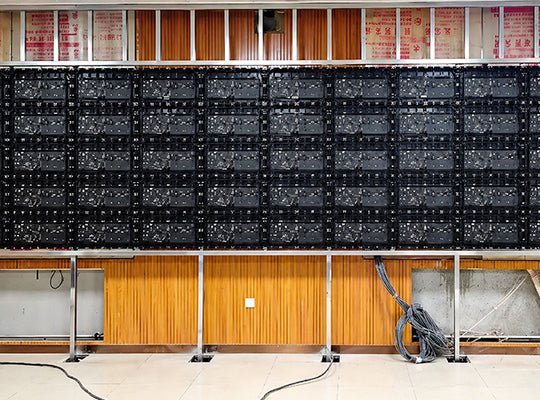
The "Repairability Index" of a screen directly impacts the long-term ROI. Many integrators ignore maintenance access until the first pixel goes out, only to find they need a crane for a simple module swap.
Following OSHA Workplace Safety Standards, our rear-maintenance walkways are never less than 600mm (24 inches) wide. For indoor retail environments, we prioritize Vacuum Front-Service technology, allowing a module to be replaced in under 60 seconds without tools.
6. Intelligent Structural Monitoring: IoT & Digital Twins
The future of LED engineering is Proactive Maintenance. We are now integrating IoT sensor arrays directly into the structural nodes to create a "Digital Twin" of the installation.
- Strain Gauges: Monitoring structural fatigue in high-wind zones.
- Tilt Sensors: For high-rise rooftop displays, alerting engineers to any structural shifting post-storm.
- Health Alerts: Cloud-based systems that notify the maintenance team the moment a fan fails or internal humidity exceeds 80%.
7. Regulatory Compliance & Global Standards Checklist
| Category | International Standard / Regulation |
|---|---|
| Structural Steel | Eurocode 3 / AISC 360 |
| Lightning Protection | NFPA 780 / IEC 62305 |
| Wind & Snow Loads | ASCE 7-22 / IBC Section 1608 |
| Workplace Safety | OSHA 29 CFR 1910 |
| Electrical Install | IEC 60364 / NEC Article 600 |
Ready for a Structural Feasibility Audit?
Precision starts at the blueprint. Our engineering team is ready to review your 2026 project goals and provide a custom structural spec-sheet.
Consult with Our Structural Engineers


Share:
Strategic Stock Update: 800sqm of VENUS LITE SERIES Now Available in Belgium Warehouse
VMX Visual at ISE Barcelona: Showcasing the Future of Micro LED & Creative Engineering