
Table of Contents
- What Is Refresh Rate?
- Why Refresh Rate Matters for LED Screens
- Technical Factors Affecting Refresh Rate
- Recommended Refresh Rates by Use Scenario
- Industry Standards & Benchmarks (China & International)
- Common Misconceptions & Pitfalls When Buying
- Buying Checklist: What to Verify Before Purchase
- Conclusion
What Is Refresh Rate?
The “refresh rate” of an LED screen refers to how many times per second the screen updates its displayed image, measured in Hertz (Hz). In simple terms: each “refresh” redraws the screen’s pixels, producing a new frame. The higher the refresh rate, the smoother motion appears, and the less likely the image is to flicker or show artifacts — especially in dynamic video or motion-heavy content.
Because human vision retains an image for a fraction of a second (so-called “persistence of vision”), if your screen’s refresh rate is too low, the flickering or rapid on/off cycling becomes perceptible. This can cause visual discomfort, motion blur, and even eye strain over time. On the other hand, a high refresh rate can render motions seamlessly, making movement appear fluid, minimizing ghosting or flicker, and providing a stable image whether you are watching directly or filming the display by camera.
Why Refresh Rate Matters for LED Screens
Here are some of the main reasons refresh rate is critical for LED screen quality and usability:
| Issue / Requirement | Low Refresh Rate (e.g. 300–1000 Hz) | High Refresh Rate (≥1920 Hz, ideally ≥3840 Hz) |
|---|---|---|
| Visible Flicker / Audience Comfort | Flicker may be visible; eye fatigue and discomfort likely over long viewing sessions | Stable image without perceptible flicker; comfortable viewing experience |
| Motion Clarity & Smoothness | Motion blur, ghosting, stutter during fast movement or camera pans | Smooth motion rendering; crisp, stable visuals during video playback or dynamic content |
| Filming & Broadcast Compatibility | Camera recordings may show scanning lines, water-ripple effects, flicker artifacts | Clean footage even when filmed; no flicker or banding — essential for live broadcasting or events |
| Professional / Commercial Perception | Lower perceived quality; may look “cheap” or unprofessional | High-end look and consistent performance — suitable for concerts, stages, broadcast, corporate events |
Therefore, refresh rate is not just a “spec number” — it directly impacts user comfort, display reliability, filming quality, and ultimately the perceived value of the LED installation.
Technical Factors Affecting Refresh Rate
Not all LED screens labeled with high refresh rates are equal. Several technical factors underlie whether a screen can genuinely achieve stable high Hz performance:
- Driver IC Type: Basic driver chips may support only up to ~960 Hz. Dual-latch (double-buffer) designs often reach ≥1920 Hz. Advanced PWM (Pulse-Width Modulation) driver ICs are typically required for stable ≥3840 Hz operation. For example, high-end LED driver families such as Macroblock’s MBI5153/MBI525x or Chipone’s ICND215x series are designed specifically for high-refresh, high-scan LED displays (see manufacturer datasheets at Macroblock or Chipone).
- PWM Dimming & Grayscale Handling: High refresh rates should not compromise grayscale depth. Proper PWM dimming ensures brightness and gray-scale consistency even at high Hz.
- Signal Transmission & Controller Hardware: To sustain 3840 Hz refresh, upstream signal lines (e.g. HDMI 2.1, DisplayPort 2.0, or dedicated LED video processors) must reliably push data fast enough. Weak controllers or slow signal paths often bottleneck performance.
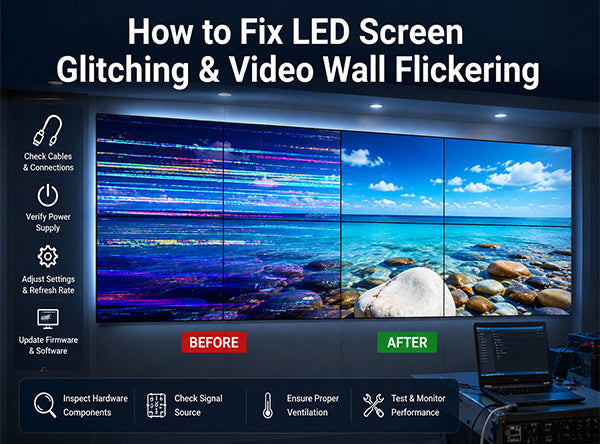
- Power Supply & Thermal Design: High-rate LED driving increases power consumption and generates more heat. Inadequate heat dissipation can lead to thermal throttling, brightness drop or flicker under load. Good LED screen design must include adequate cooling and power regulation.
-
Module & Cabinet Build Quality: Poor soldering, weak connectors, or low-quality PCB/wiring may introduce instability. Even the best driver chips will fail to maintain high refresh rate if hardware assembly or wiring is subpar.

Recommended Refresh Rates by Use Scenario
Your target refresh rate should depend on how and where the LED screen will be used. Over-specifying is as undesirable as under-specifying. Below is a rough guideline:
| Use Scenario | Recommended Refresh Rate | Reason / Notes |
|---|---|---|
| Static signage, simple information display (text, still graphics) | 300 – 600 Hz | Motion is minimal; low power consumption enough; no flicker under normal viewing |
| Indoor commercial displays, retail displays, business lobbies | ≥ 1920 Hz | Ensures smooth video playback and comfortable viewing; avoids visible flicker during dynamic content |
| Stage rental, concert LED walls, live events | ≥ 3840 Hz | Needed for filming, broadcast-quality video, and fast-motion content; ensures stable visuals under camera recording or live performance lighting |
| Film production, XR / Virtual stage, high-end broadcast studios | 3840 – 7680 Hz (or more) | Ensures absolutely flicker-free footage, ideal for high-frame-rate cameras and professional video capture |

Industry Standards & Benchmarks (China & International)
To ensure consistency and quality across manufacturers and suppliers, several official standards govern LED display performance.
- China – SJ/T 11141-2025 “LED Display General Specification”: Released May 9, 2025, and planned to be implemented from August 1, 2025. This standard updates earlier SJ/T versions (for example the 2017 edition) and sets clearer performance reference values for LED products, including recommended minimum refresh rate levels for static and video applications. The official text can be obtained through the Ministry of Industry and Information Technology (MIIT) and China’s standards publishing platforms (e.g. miit.gov.cn and national standard service websites).
- IEC (International Electrotechnical Commission) Standards, e.g. IEC 62341 Series: These provide measurement methods for optical and electro-optical parameters of emissive displays (including LED/OLED modules), such as luminance, color, stability, and uniformity. While focused primarily on modules rather than full assembled screens, they serve as a reference for brightness, color-accuracy, and flicker-related testing. Official catalogue: webstore.iec.ch.
- Safety & Product Compliance Standards, e.g. UL 8750 (LED Equipment Safety) / ISO 9241-307 (Visual Ergonomics, Flicker Measurement): These standards help ensure LED devices meet safety, electromagnetic compatibility (EMC), and ergonomic requirements — critical when LED screens are used in commercial or public settings. More information can be found at the UL Standards Catalog (standardscatalog.ul.com) and ISO (iso.org).
By choosing LED products designed and tested in line with these standards, purchasers can better ensure baseline performance, safety, and long-term reliability, and have clearer benchmarks for supplier comparison and quality control.
Common Misconceptions & Pitfalls When Buying
Many buyers assume “higher refresh rate is always better” or “once a spec says 3840 Hz, it's guaranteed good.” That is not always true. Here are common misconceptions and pitfalls:
- “Any 3840 Hz is fine” — Not necessarily. If driver ICs, signal processing, or power supply design are poor, actual performance will suffer.
- Equating refresh rate with frame rate — Refresh rate (Hz) is about how often the screen updates per second; frame rate (fps) is about how many unique images per second the source provides. A high refresh rate doesn’t fix a low frame-rate video, but ensures smoother presentation of whatever frames you do output. Mistaking one for the other leads to misjudgment. In professional camera guidelines for shooting LED walls (such as ARRI’s virtual production recommendations), it is clearly noted that high-refresh LED walls are important for rolling-shutter cameras to avoid flicker and banding under various shutter speeds and frame rates (see ARRI Virtual Production resources).
- Ignoring thermal and power considerations — High-refresh LED walls consume more power and generate more heat; without proper cooling, brightness may drop or flicker may occur over time.
- Assuming high refresh rate ensures quality in every aspect — Refresh rate is just one among many parameters (brightness, gray-scale depth, color accuracy, uniformity, maintenance access, reliability). Focusing only on Hz may ignore other critical quality dimensions.
-
Buying based only on spec sheets — Real-world testing (flicker under camera, grayscale consistency, signal stability) is needed; some manufacturers may over-promise specs that don’t hold under realistic conditions.

Buying Checklist: What to Verify Before Purchase
Before committing to an LED screen purchase, especially for commercial or professional use, make sure to check and test at least the following:
- Driver IC type & technical documentation — ensure dual-latch or high-end PWM driver ICs are used if 3840 Hz or higher refresh is claimed (request the specific IC model and datasheet).
- Controller & signal chain (video processor, cables, data transmission protocol) — ensure they can support high frame rates and high data rates without drop or delay.
- Power supply capacity and thermal design — verify that continuous high-rate operation doesn’t cause overheating or brightness drop.
- Manufacturing quality — soldering, PCB design, wiring, connectors; these affect long-term stability and help avoid artifacts or failure.
- Brightness, grayscale depth, color uniformity, viewing angles — ensure the display remains true to color even at varying brightness or after hours of operation.
- Maintenance & serviceability — confirm the ability for module-level maintenance (front or rear servicing), easy replacement of modules or power supplies.
- Compliance with recognized standards — for example, alignment with national or international standards and best practices (e.g. SJ/T 11141-2025 where applicable, IEC 62341 series, UL 8750, ISO 9241-307) for quality assurance and safety.
- Field testing under real conditions — simulated video playback, camera recording, and different ambient lighting conditions — to confirm flicker-free, stable performance.
Conclusion
For LED displays, refresh rate is far more than a marketing number — it directly impacts visual comfort, motion clarity, filming reliability, and overall display professionalism. A properly selected refresh rate ensures stable, high-quality output, whether for a retail screen, a corporate lobby, a concert stage, or a broadcast set.
But high refresh rate alone does not guarantee quality. What matters is the complete system: driver hardware, controller, power supply, thermal design, signal integrity, and manufacturing quality. Always verify specifications with real-world testing rather than relying solely on what is written on paper. Match screen specs to your actual application scenario rather than blindly chasing the highest numbers.
If you are equipping an LED wall for live performances, events, or filming — aim for refresh rates ≥ 3840 Hz, with verified hardware and good engineering. For simple advertising or static signage, 300–600 Hz may suffice. Selecting the right LED screen is about balancing performance, reliability, cost, and use-case suitability.


Share:
VMX Visual Shines at the 2025 LDI Show with Breakthrough Product Performance
VMX Visual Shines at the 2025 LDI Show with Breakthrough Product Performance